







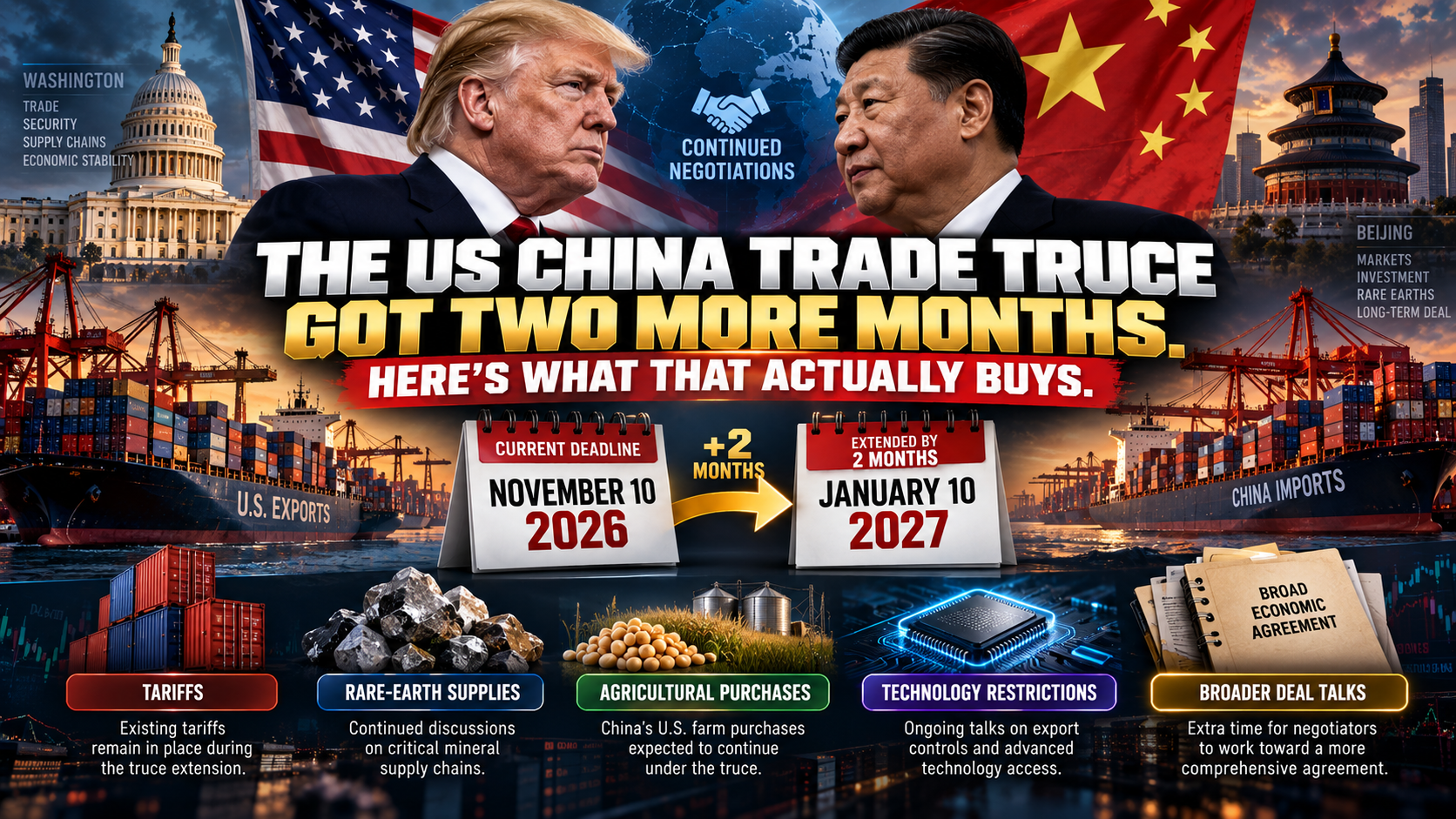
Xi Jinping’s plane had barely touched down at Joint Base Andrews on Wednesday evening when the headline landed with it: the US China trade truce would survive. Treasury Secretary Scott Bessent told reporters the deal between the world’s two largest economies would not expire in November after all. It would run until 10 January.
That is two months. Before the summit, most analysts had expected six months or longer.
The truce survived the most elaborate state visit Washington has staged in years, and that is the good news. The less comfortable reading is that the extension is short enough to function as a deadline rather than a reprieve. Bessent said the extra time would let both sides “see what we can do on the economic front,” while noting that Beijing still needs to fulfil more deliverables. In other words, Washington has kept the pressure on while removing the risk of an immediate blow-up.
What the US China trade truce extension actually covers
The arrangement dates back to last October, when Trump and Xi met in Busan, South Korea. There, they agreed a one-year pause in a trade war that had pushed some tariffs above 100%. That war had threatened to snap global supply chains. That deal, originally set to lapse on 10 November, has now been pushed to 10 January 2027.
Nothing in the core architecture changes. The existing tariff levels stay where they are. Neither side adds new restrictions in the interim. The central disputes, however, have simply been moved down the road. As Reuters summarised it, the extension pushes tariffs, Chinese purchases, rare-earth supplies and technology restrictions into the next round of talks rather than locking in anything durable.
Several items were on the table heading into the week. Markets were watching for progress on a mutual tariff reduction covering roughly $30 billion in goods. In May, the White House said China had committed to buying at least $17 billion a year in American farm goods. That pledge covers 2026, 2027 and 2028, on top of earlier soybean deals. Trump had also suggested that China might order as many as 750 Boeing aircraft. However, Boeing chief executive Kelly Ortberg played down hopes of a new order around this summit.
Consequently, the most concrete outcome of the week is a date on a calendar rather than a signed package.
The summit itself: pageantry, AI and very little on Taiwan
On Thursday, Trump welcomed Xi to the White House. The talks covered trade, AI, Taiwan, Ukraine, the Middle East and the Korean Peninsula. It was Xi’s first state visit to the United States since 2015. Trump met him on the tarmac, a rare gesture for a US president. Afterwards, he called the meeting very productive for both countries.
Beneath the ceremony, the substance was thin. The talks ended without a clear breakthrough on Taiwan, AI or advanced chips. The White House summary did not disclose any specific remarks from Trump on Taiwan. Beijing, for its part, stressed the phrase “constructive strategic stability,” first used when Trump visited China in May. It also framed cooperation as the centre of the relationship, with competition kept at an “appropriate level.”
There were, nevertheless, a few genuinely new threads.
Artificial intelligence. China confirmed that the first bilateral AI talks with the United States have now taken place. Separately, Bessent floated an AI “notification mechanism” between the two governments. In time, that could lead to a shared framework for how the technology is governed. That is modest. Still, it is the first time AI has moved from a trade dispute to an agenda item with its own channel.
More meetings. The two presidents now expect to meet twice more in the coming months, in Shenzhen and Miami. That cadence matters more than any individual communiqué, because it keeps the relationship in a managed rhythm through the January deadline.
Soft diplomacy. In a telling detail, reports say an Atlanta zoo will receive pandas. Xi is reviving one of China’s oldest diplomatic tools.
Why neither leader could afford a fight
Bloomberg’s framing was blunt: Trump and Xi bought time on trade because neither was able to afford a fight. Both sides had strong domestic reasons to keep this quiet.
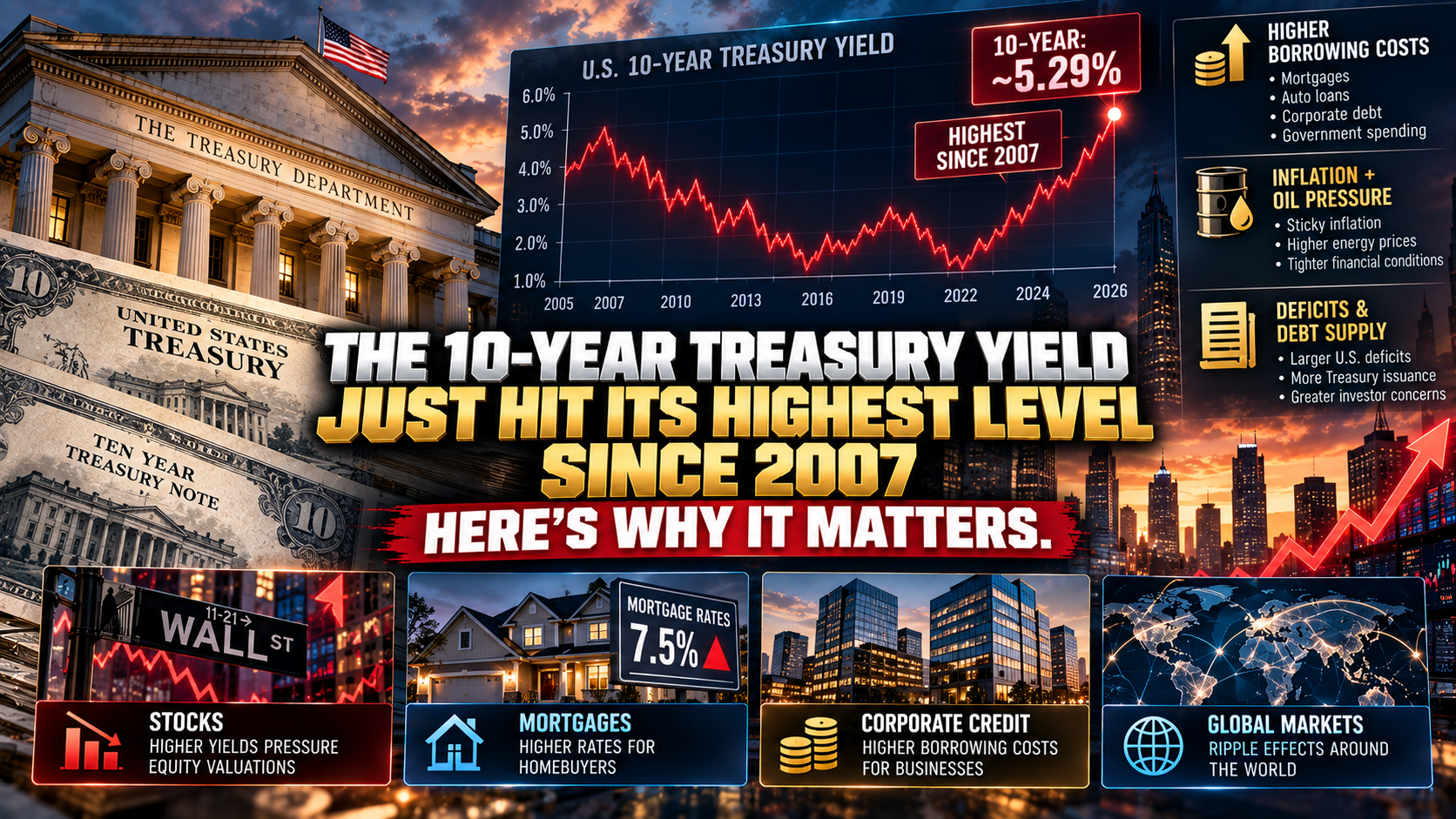
For Trump, the midterm elections are less than six weeks away, and control of Congress remains truly in doubt. The campaign is being fought on the cost of living. Diesel has hit record highs above $6.50 a gallon. The 10-year Treasury yield has climbed to its highest level since 2007. Meanwhile, 30-year mortgage rates have just crossed 7% for the first time since early 2025. A tariff shock layered on top of all that would be politically disastrous.
For Xi, the calculation is different but no less pressing. China’s export engine has been strong, yet the domestic economy is not. Retail sales have been weak, fixed-asset investment has contracted and Beijing has had to inject capital into state banks to keep credit flowing. A rupture with Washington would hit the one part of the Chinese economy that is currently working.
Moreover, China holds leverage that constrains how hard Washington can push. Analysts have repeatedly cited its dominance in rare earths and critical minerals. That leverage is one reason the White House took a softer approach into this summit.
“Hostile, but hooked”
Al Jazeera captured the dynamic with a phrase that is worth borrowing: the two countries are hostile, but hooked. The strategic rivalry is deepening across technology, military posture and supply chains. At the same time, the economic ties is too large for either government to walk away from.
Some analysts argue the truce extension is pure optics, a way for both leaders to show a calm front without conceding anything. Others see it as a useful practical step that keeps talks alive long enough to reach a larger agreement. Both interpretations can hold at once. The short duration arguably proves the first point, while the scheduled follow-up meetings support the second.
One Chinese academic, Dong Shaopeng of Renmin University, suggested the truce could be “continually improved and extended.” That is probably the most realistic expectation: a series of rolling short-term extensions rather than a single big deal.
What the US China trade truce means for markets and consumers
Markets had largely priced in an extension, which is why the reaction was muted. Schwab’s pre-market note on Friday observed simply that the meetings failed to forge any trade breakthroughs. Stocks rose anyway, helped more by falling oil prices than by anything that came out of the White House.
For households and businesses, the practical implications are as follows.
- Tariff levels are frozen, not reduced. Prices on imported Chinese goods should not jump in the near term, but nor should anyone expect relief at the checkout before January.
- Holiday-season inventory is protected. Retailers who import from China can plan the fourth quarter without fearing a November tariff cliff. That removes one risk from an already expensive season.
- Farm states gain some clarity. Agricultural purchase commitments remain the most tangible part of the relationship. Fulfilment has lagged intent in the past, so watch the monthly purchase data rather than the rhetoric.
- Tech and chip stocks remain exposed. With no progress on chips or export controls, companies selling into China carry the same regulatory uncertainty they had a week ago.
In practice, the most important date for anyone with exposure to US-China trade is now 10 January 2027, not 10 November.
How the truce got here: a short timeline
- October 2025: Trump and Xi meet in Busan and agree a one-year pause in a trade war that had pushed some reciprocal tariffs above 100%.
- May 2026: Trump visits Beijing. The two sides adopt the language of “constructive strategic stability” and China commits to larger farm purchases, but no full deal or joint communiqué emerges.
- 20 September 2026: Bessent and Vice Premier He Lifeng open groundwork talks in New York.
- 23 September 2026: As Xi lands, Bessent announces the truce will run to 10 January 2027.
- 24 September 2026: The leaders meet at the White House and agree to keep talking, with further meetings planned in Shenzhen and Miami.
What to watch next
Firstly, watch whether the two sides announce anything specific on agriculture and non-tariff barriers. US Trade Representative Jamieson Greer said earlier this month that such announcements were coming. They would be the clearest sign the extension is producing substance.
Secondly, watch the rare-earth file. Any Chinese move on export licences for critical minerals will reveal more than any summit statement.
Thirdly, watch the calendar. Two more leader-level meetings leave room for a larger deal. However, they also create two more chances for talks to break down in public.
Ultimately, this summit delivered exactly what both leaders needed and very little that either can sell as a victory. The US China trade truce is intact, the tariff cliff has moved to January, and the hard questions remain unanswered. For a relationship this fraught, managed stalemate is still the best available outcome, and both governments seem to know it.