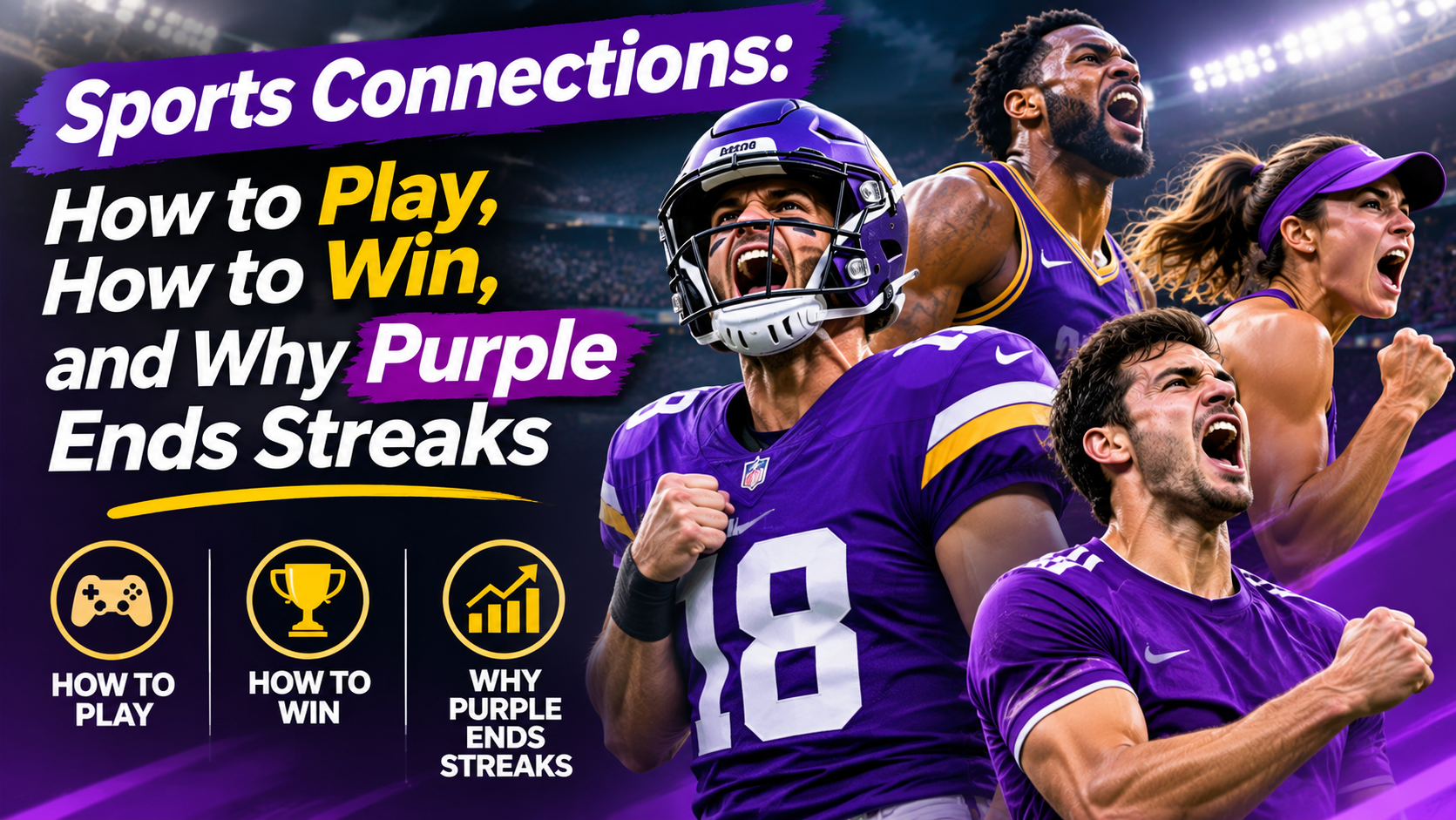




Every day at midnight, a four-by-four grid of sports words goes live and ruins somebody’s breakfast. Sixteen terms, four hidden groups, four wrong guesses before the game ends. That is the whole of sports connections, the daily puzzle The Athletic runs with New York Times Games, and it has quietly become one of the stickiest habits in American sports media.
The format looks almost too simply to be hard. It is not. The grid is built so that the grouping you spot first is usually the one designed to cost you a life, and the category that decides your streak is rarely the one you felt confident about.
Here is how the game works, why one group breaks so many runs, and the approach that turns a daily coin flip into a routine solve.
What Sports Connections actually is
The game is a sports-themed version of the standard Connections puzzle. The Athletic launched it in partnership with New York Times Games as its first daily game, inviting players to sort 16 sports terms into four categories of four, with only four mistakes allowed. A new grid posts every day at midnight local time, and the puzzle editor is Mark Cooper, The Athletic’s managing editor for news.
It arrived quietly. The Athletic ran it in beta through the spring of 2025 before launching it properly around the Super Bowl, when the sports audience is at its largest. Cooper’s reasoning for why the format suits sports was straightforward. Fans are competitive, they like games, and the subject is full of overlapping names, terms and statistics that make good board material.
It is also free to play on The Athletic’s site and app with no subscription required, which separates it from most of the publication’s output. By early November 2026 the daily count had passed puzzle number 770, which is roughly 21 months of unbroken daily publication.
The rules, in thirty seconds
- Sixteen words sit in a four-by-four grid. Four belong together, then another four, then another, then the last four.
- Select four and submit. A correct group locks in and takes a colour.
- A wrong group costs one of your four lives. A message reading one away means three of your four are right.
- Four mistakes end the game and reveal the remaining answers.
The colours are a difficulty ladder. Yellow is the most direct, green a little less so, blue harder again, and purple is the group most likely to end your run.
How the ladder usually works
A representative grid from 1 November 2026 shows the ramp clearly. That day’s four categories were football penalties, football team stats, types of wrestling and relay race terms. The first two are plain vocabulary. The third asks you to separate folkstyle from Greco-Roman. The fourth asks you to think about a single event rather than a whole sport.
Why purple breaks sports connections streaks
Purple is where the editing happens.
In the original Connections, the purple group almost always carries some kind of wordplay, and Cooper has said the sports edition tries to do the same thing. That means purple frequently has very little to do with sports knowledge. Instead, it tests whether you can stop reading the words as sports words at all.
Three patterns recur.
Hidden words. Four entries that each contain, begin with or follow the same word. One early November 2026 grid built its purple group entirely from terms that follow the word goal: goal line, goal post, goal mouth and goal crease.
One letter off. Four entries that become something else when a single letter changes. GLIDER, TINKER, BUTTER and CORKBALL look like noise until you swap the first letter of each and find four baseball pitches underneath.
Pure language categories. In March 2026, one purple group was simply palindromes: KAYAK, POP, RADAR and STATS, with the sports link reduced to a single word.
None of that reward knowing more about sport. They reward reading the grid twice.
Seven habits that protect a streak
- Look for purple first, even if you cannot solve it. You do not have to crack it. You only need to know which four words are unavailable to the other categories. Spotting the trick early removes the single biggest source of wrong guesses.
- Count how many groups each word could join. A word that plausibly fits three categories almost never belongs to the one you want it in. Genuine members usually have exactly one comfortable home.
- Read every word twice, and once out loud. Wordplay groups rely on you reading JUDGE as a baseball surname when the puzzle wants a verb, or DRESSING as a medical supply when the puzzle wants a salad. Saying a word aloud breaks the first reading.
- Distrust the clean foursome. If four words obviously belong together, check whether a fifth candidate is sitting elsewhere in the grid. Editors routinely build an obvious group of five and then pull one of them into a harder category.
- Spend your first submission on certainty. There is no bonus for solving in order and no clock running. A group you are almost sure of is worth more as an opening move than an interesting hunch, because locking four words away shrinks every decision that follows.
- Use one away by swapping, not rebuilding. When the game tells you three are correct, change a single word and resubmit. Rebuilding the whole group throws away information you have just paid a life for.
- Learn the recurring furniture. Hall of Fame cities, AFC and NFC divisions, stadium food, equipment brands, officiating signals, playing positions and scoring terms come round again and again. Recognising a familiar category type is often faster than reasoning from the words themselves.
The traps worth naming
The shared-sport trap. Four baseball words in one grid rarely form a baseball category. More often, two belong to a scoring group and two belong to a wordplay group.
The surname trap. Coaching and playing surnames that double as ordinary words are the most reliable misdirection in the game. Drew, Judge, Few and Payton all read as something else first.
The near-synonym trap. Grit, guts, mettle and moxie look interchangeable, which is exactly why one of them often belongs somewhere else entirely.
Hints, answers and when to use them
Plenty of sites publish daily sports connections hints and full solutions, and they are not all equally useful. A tiered hint, which names the theme of one category without naming its members, keeps the puzzle intact. A full answer grid ends it.
If the streak is going to mean anything, the honest order runs like this. Solve what you can, take one category hint if you are stuck, then look up the rest only after the game is over. The valuable part of the puzzle is the twenty seconds before you see the trick, not the solution itself.
Why a word game sits inside a sports publication
A daily puzzle is a retention product. It gives readers a reason to open an app at the same time every day without an event to pull them there, and it costs far less to produce than live coverage. Cooper has said he hopes players move on to The Athletic’s other reporting once they have finished the grid.
That logic has spread quickly. Word games now sit beside standings and injury reports on most major sports platforms, and the sports-trivia format travels well because the vocabulary is enormous and genuinely shared across millions of fans.
The bottom line
Sports connections is not a trivia quiz with a grid on top. It is a logic puzzle that happens to use sports vocabulary, and the players holding long streaks treat it that way. Find the awkward words first, commit to the group you can prove, and read purple as language rather than sport.
Four mistakes is a generous allowance until you spend three of them on your opening two guesses. Slow down, and the grid gets a great deal smaller.