




The Sports America | Sports in the United States

Thursday, September 24, 2026
Fed rate

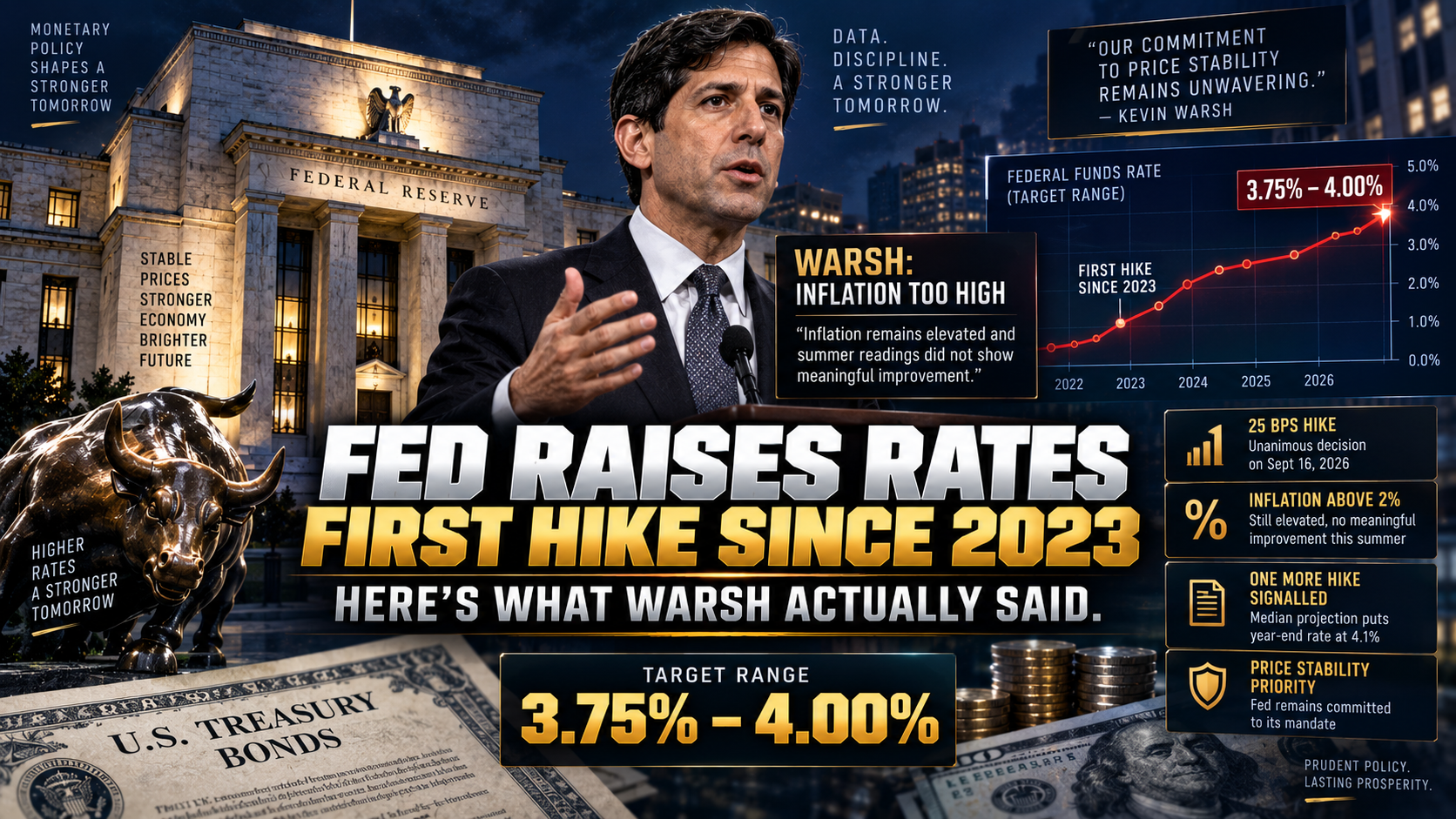
The Fed Rate Just Raised for the First Time Since 2023. Here’s What Warsh Actually Said.

The Fed rate hike September 2026 was unanimous. The Federal Open Market Committee voted 12-0 to lift the federal funds target by 25 basis points to a range of 3.75%-4%, having left rates unchanged at the first five meetings of the year. The statement was brief and unusually direct: inflation remains elevated, and the action would support a timelier return to the 2% goal. Chairman Kevin Warsh, hand-picked for the role by President Trump, was the one who delivered it. That detail is doing a lot of work in how Washington is reading this. What the Fed rate hike September 2026 actually signals Warsh framed the decision in a specific way at his press conference. “We removed a dose of accommodation so that financial and credit conditions would be more consistent with our ultimate objectives,” he said, adding that today’s action “starts to show we’re serious about this.” That phrasing is the tell. A central bank that describes a hike as removing accommodation is saying policy was too loose, not that policy is now tight. Warsh made the point explicitly: he would be “hard-pressed to describe broad financial conditions as restrictive.” He was equally blunt about the trajectory of prices. Inflation has been “too high for too long,” he said, and “this summer’s inflation readings do not tell me that underlying trends have meaningfully improved.” Inflation has now been elevated for roughly five years, and this year’s acceleration has been driven substantially by the war with Iran and the energy shock that came with it. Warsh acknowledged the Fed cannot single-handedly stop a price shock in oil. Its job, as he described it, is preventing that shock from broadening into general inflation. The dot plot is the real story The decision itself was priced in. The projections were not. Sixteen of eighteen participants expect at least one more increase before the end of this year. Four of those see the possibility of two more. Only two participants expect the committee to stop here. There is not a single dot projecting a cut in 2026, which is a marked shift from June, when nine members projected a hike, eight projected no change and one still expected a reduction. Warsh himself did not submit a dot, as he also declined to do in June. That is deliberate. He has been consistent about not offering markets forward guidance, which makes the median projection more informative than usual because it reflects the committee rather than the chair. Looking further out, the picture flattens quickly. Only eight policymakers project another 25 basis points in 2027. Beyond that, the projections indicate roughly one cut in 2028 and at least one in 2029. So this is not the beginning of an extended hiking cycle. It is, on the committee’s own numbers, a short corrective move. Markets updated accordingly. The probability of at least one more hike this year rose to about 87% after Warsh’s remarks, up from 77% that morning. Odds of two more increases moved from 27% to 37%. Goldman Sachs Asset Management expects the next move in December. The committee also nudged its forecasts. Headline PCE inflation is now seen at 3.7% this year, falling to 2.3% in 2027. Unemployment projections were revised down from 4.3% to 4.1% for both 2026 and 2027. Why the labour market made this possible A central bank cannot fight inflation while employment is collapsing. It is not collapsing. August payrolls grew by 162,000, far above the 53,000 economists had expected, and the unemployment rate held steady at 4.1%. Warsh pointed to labour data, private sector earnings and capital investment as evidence that “the American economy appears to be strengthening,” and noted that job openings and weekly hours are rising. That resilience is what gives the committee room to focus on prices. It is also what makes the hike defensible to a public that has spent five years watching the cost of living outrun wages. Warsh leaned into that argument, framing the decision as good news for Americans who do not own financial assets or have significant home equity. Price stability, he said, is what allows people to “put their head above water and deliver real take-home pay increases.” The politics nobody can ignore The Fed rate hike September 2026 puts Warsh directly at odds with the president who appointed him. Trump has campaigned relentlessly for lower borrowing costs. Vice President JD Vance argued earlier this month that the Fed should cut rates to make homes more affordable. Within hours of the decision, Trump posted on his own platform: “LOWER THE INTEREST RATES FOR THE UNITED STATES OF AMERICA, AND FAST!” He stopped short of criticising Warsh by name. National Economic Council Director Kevin Hassett had already said the president would accept the decision. Asked directly about those conversations, Warsh gave the answer that will define his tenure if he keeps giving it. “I don’t have anything for you on discussions with the President, and I am not a Wall Street newsletter,” he said. “Part of the independence of the Federal Reserve is we stay in our lane. Independence is a two-way street.” That last line is the one worth remembering. It commits the Fed to staying out of trade and fiscal policy in exchange for the same courtesy. Whether it holds through an election autumn is an open question. Fed Rate What it means for your money Borrowers pay more. Mortgage rates, credit card APRs, auto loans, home equity lines and small business credit all reprice off the federal funds rate, most of them within weeks. If you carry a variable-rate balance, the cost of servicing it just went up and is expected to go up again. Savers finally gain. High-yield savings, money market funds and short-dated Treasuries all benefit. With another hike likely before December, there is a reasonable argument for staying short rather than locking in longer-duration fixed income now. Refinancing maths has changed. The window that existed earlier this year is closing. Anyone who had…


Read More
Nvidia AI chip demand

Nvidia AI Chip Demand Has Never Been Higher. So Why Is the Stock Lagging?

Nvidia became the most valuable company on earth by selling the picks and shovels of the artificial intelligence boom. Its revenue grew 65% last fiscal year to $215.94 billion. Most recent quarter showed year-on-year growth above 100%. Its chief executive said last week that the company will sell twice as many chips next year as it does this year.That gap between operating performance and share price is the most interesting thing in technology investing right now. Nvidia AI chip demand is not the question anymore. The question is how much of the money flowing into AI infrastructure Nvidia gets to keep. What the numbers actually say about Nvidia AI chip demand Start with the company’s own guidance, because it was unusual. Nvidia typically issues quarterly projections. Last month it broke that habit and forecast a 70% jump in next fiscal year’s revenue, alongside a second quarter that beat on both revenue and profit. Issuing an annual guide is a deliberate signal: management is telling the market that visibility extends well beyond the next three months. The reaction was immediate. At least sixteen brokerages raised their price targets, with LSEG data pointing to strong demand for the next-generation Rubin processors. Chip-linked names rallied in a move worth nearly $150 billion across the sector, with Intel, Micron, Broadcom and US-listed SK Hynix shares all rising. AI cloud companies backed by Nvidia, including CoreWeave and Nebius, gained between 2% and 4.5%. Then Jensen Huang went further. Speaking last Thursday, he said he expects Nvidia to sell twice as many chips next year as this year. That is not a demand-constrained company talking. The underlying driver is hyperscaler capital expenditure, which keeps climbing. Microsoft, Meta, Alphabet and Amazon have all raised capex guidance repeatedly, and much of that spending lands in Nvidia’s revenue line. Memory supply is tight. Custom silicon backlogs stretch visibility into 2028. So why is the stock lagging? Four pressures explain the disconnect. Competition is finally real Huawei is accelerating the launch of its own AI chip, and Nvidia shares slipped on that news last week. That matters less for the American market than for the Chinese one, but China has been a meaningful share of demand and is increasingly closed by export controls. More significantly, Nvidia’s own customers are building alternatives. OpenAI and others have been developing in-house chips specifically to reduce dependence on processors that are both expensive and supply-constrained. Every hyperscaler that successfully deploys custom silicon is a customer buying fewer GPUs than it otherwise would. The circularity problem Nvidia has taken equity stakes in companies that are also its customers. CoreWeave and Nebius are the clearest examples. Critics argue this inflates the apparent strength of AI demand: money goes out as investment and comes back as revenue. The counterargument is that these are genuine businesses buying genuine hardware, and that strategic investment in an emerging customer base is ordinary corporate behaviour. Both readings have merit, and the market has been unable to settle between them, which is precisely why the multiple has compressed. Valuation scepticism across the AI complex Not every AI stock riding this year’s rally has growth that lasts, and portfolio managers have started saying so publicly. Chip stocks wobbled earlier this month on commentary about potential AI development pauses from major labs. California’s governor signed an executive order aimed at reining in AI companies, including provisions described as an “AI kill switch.” Regulatory risk has moved from theoretical to scheduled. Rates The mechanical one. The Federal Reserve raised interest rates last Wednesday for the first time since July 2023, taking the target range to 3.75%-4%, with sixteen of eighteen officials expecting another increase before year-end. The ten-year Treasury yield has pushed toward 5%. Higher discount rates compress the present value of future earnings, and no sector is more exposed to that maths than long-duration growth technology. The valuation argument is genuinely interesting Here is the detail that gets overlooked. Nvidia trades at a forward price-to-earnings ratio of about 17.9. Advanced Micro Devices trades at roughly 37.2. Intel is near 46.2. The most dominant company in the sector is also the cheapest on forward earnings, because analyst estimates have risen faster than the share price. That is not a bubble signature. That is a stock where expectations have lagged results. Consensus sits at a Buy rating with an average twelve-month target in the $324 to $329 range against a share price that closed near $228 in late August, implying meaningful upside. One analyst has put a $350 target on the stock, which would imply a market capitalisation around $8.5 trillion. None of that is a recommendation. It is context for why the “Nvidia is overvalued” conversation and the “Nvidia is undervalued” conversation are both happening loudly at the same time. The signals worth tracking Insider activity. Nvidia’s chief financial officer, Colette Kress, sold 34,900 shares on 17 September in a transaction worth $7.65 million. Routine planned sales are normal at any company with equity compensation, but the market notices them in a stock this debated. Acquisition strategy. Reports have placed Nvidia in advanced talks to acquire the AI platform Hugging Face for somewhere between $12.9 billion and $14 billion. If completed, that would extend Huang’s push beyond chips into the software layer, which is where margins ultimately consolidate in any hardware cycle. Geopolitics. Nvidia and OpenAI executives are expected at the state dinner for Xi Jinping in Washington on 24 September. Export controls, AI cooperation and critical minerals are all on the summit agenda. Few companies have more direct exposure to the outcome. Talent. One underappreciated constraint: analysis this month suggested the US needs roughly 157,000 more workers to staff its AI chip ambitions. Fabs and data centres require people, and that is not a bottleneck money solves quickly. The Rubin cycle and what has to go right Every hardware cycle eventually runs into the same three constraints, and Nvidia is approaching all of them simultaneously. Supply. Analyst notes following the most recent results…

Read More
oil prices today

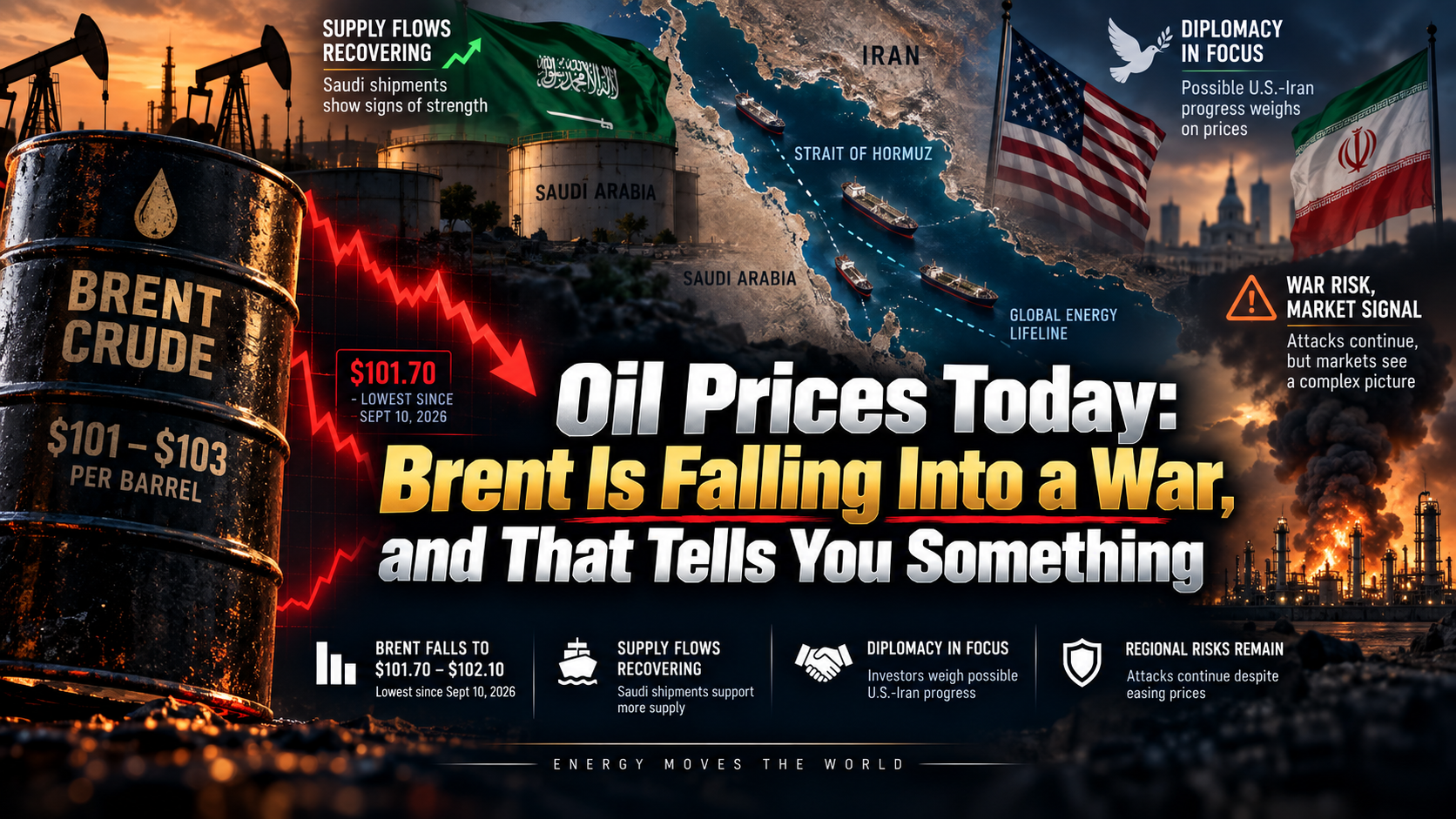
Oil Prices Today: Brent Is Falling Into a War, and That Tells You Something

On Saturday, Iran-backed Houthi forces fired missiles and drones at Saudi Arabia. Riyadh issued air-raid alerts for the first time since the height of the US-Iran war in the spring, and warnings went out across Red Sea hubs including Yanbu. By any normal reading of an oil market, crude should have gapped higher on Monday.Oil prices today extended a decline that is now in its fourth session, the longest losing run since June. Brent for November delivery dropped 1.71% to $102.09 a barrel while West Texas Intermediate for October fell 1.96% to $98.33. That is a market telling you something, and what it is telling you is that traders have stopped pricing escalation and started pricing an exit. Why oil prices today are falling into a war The simplest explanation is diplomacy. President Trump told Fox News he would “probably” be open to meeting Iranian President Masoud Pezeshkian on the sidelines of the UN General Assembly in New York this week. He is also holding a summit with Xi Jinping and may meet Gulf leaders. None of that constitutes a deal. All of it constitutes a meaningful change in tone from a conflict that has driven energy markets for most of 2026. The second explanation is that supply has held up far better than the headlines suggest. Admiral Brad Cooper, head of US Central Command, said crude and liquefied natural gas flows through the Strait of Hormuz over the past two weeks are running at a six-month high. JPMorgan analysts noted in a 18 September client note that Middle East oil flows have remained surprisingly strong despite the disruption to Saudi Arabia’s East-West pipeline. That pipeline matters enormously. It was shut down on 11 September after strikes by Iran-affiliated forces, removing the ability to route roughly seven million barrels per day to the Red Sea as an alternative to the blockaded Persian Gulf. Saudi Aramco has since indicated it expects to restore a significant share of those flows, and has been telling refining customers what to expect. The market has taken that guidance at face value. The scale of what the market is shrugging off It is worth stating plainly how unusual the current supply situation is, because the falling price obscures it. The International Energy Agency has characterised the disruption from the Strait of Hormuz and Bab al-Mandab crises as the largest supply disruption in the history of the global oil market. Saudi production recently fell to its lowest level since 1990. The US Strategic Petroleum Reserve sits near a record low. Aramco has told at least two European refining customers they will receive no crude next month. Against that, Brent is trading near $102 rather than the $147.50 all-time high set in July 2008, or even the $118 peak it touched in late March this year. The price has been volatile rather than parabolic: roughly $70 by the start of July, back above $100 by late July, fluctuating between $87 and $97 through August, then up to $109 in early September and a four-month high of $106 last Tuesday before this week’s slide. That pattern is not a market in panic. It is a market that has spent six months learning how much disruption the system can absorb, and repeatedly concluding the answer is “more than we thought.” What cheaper oil means beyond the pump For inflation and interest rates This is the connection most people miss. The Federal Reserve raised interest rates last Wednesday for the first time since July 2023, taking the federal funds target to 3.75%-4%. Chairman Kevin Warsh was explicit that the inflation forcing his hand has been driven substantially by energy prices. He was equally explicit that the Fed cannot solve an oil shock. What it can do is prevent that shock from broadening into general price pressure, which is what the hike was designed to achieve. So every session that oil prices today spend falling weakens the case for the additional hike that sixteen of eighteen FOMC officials currently expect before year-end. Traders currently put the odds of another increase at around 87%. A sustained move below $100 would start eroding that number. For the American consumer Diesel above $6 a gallon has been one of the defining economic facts of 2026, and inflation has been stuck near 3.4%. With midterm elections in November, the political salience of fuel prices is about as high as it gets. That is part of why the administration’s posture has softened toward talks. For refiners and exporters China exported 6.01 million tonnes of refined fuels in August, up 12.7% year on year, with jet fuel exports hitting a record high. Chinese and South Korean refiners have picked up most of the volume still moving through Hormuz. Further easing of Chinese export controls would let those refiners capture stronger overseas margins, which would add supply to a product market that has been tighter than the crude market all year. What it means at the pump and along the supply chain The retail consequences of this year’s energy shock have been severe and are only partially reflected in the futures price. Diesel has been running above $6 a gallon in the United States, which feeds directly into freight costs and therefore into the price of almost everything that moves by road. Headline inflation has been stuck near 3.4%. With midterm elections in November, that combination has made fuel prices one of the most politically charged numbers in the country. Shipping economics have been reshaped as well. With Persian Gulf tanker traffic constrained and Red Sea routes threatened, voyage lengths have extended and insurance premiums have risen sharply. A supertanker shortage now threatens long-haul crude flows, which adds cost even when the barrels themselves are available. That is a structural drag that persists after the headline price falls, because charter rates and insurance reprice on a slower cycle than crude does. Fertiliser costs, which track natural gas, have driven food security concerns in several import-dependent economies since the…

Read More
stock market today

Stock Market Today: Why Futures Rose After the Dow’s Third Straight Losing Week

The Dow has now lost ground for three consecutive weeks. It fell 1.7% over the last five sessions alone, its worst run since March. And yet on Monday morning, futures across all three major indices were pointing higher.That contradiction is the whole story of the stock market today. Investors are not buying because conditions improved. They are buying because two specific pressures oil and bond yields eased at the same moment, and because a summit that could have gone badly now looks like it will merely go quietly. Where the stock market today opened S&P 500 futures rose 0.6% and Nasdaq 100 contracts climbed 0.8% in pre-market trading, with Dow futures up around 0.7%. Technology led the advance across Asian, European and US markets. Treasuries rallied across the curve, with European government bonds outperforming. The dollar traded flat. The context matters more than the percentages. Last week the S&P 500 finished roughly unchanged, down about 0.1%. The Nasdaq managed a 0.7% gain on the back of continued AI enthusiasm. The Dow did the damage, sliding 1.7% as rate-sensitive and industrial names absorbed the reality of a central bank that has started tightening again. By Friday’s close the S&P 500 sat at 7,650.50 and the Dow at 51,683, with the ten-year Treasury yield having pushed back toward 5.00%. That yield is the single most important number on the screen right now, and it explains almost everything about sector rotation this month. The two things that changed over the weekend Oil finally broke Brent crude fell for a fourth consecutive session, its longest losing streak since June, trading near $102 a barrel while West Texas Intermediate slipped below $100. That came despite Iran-backed Houthi forces launching missile and drone attacks on Saudi Arabia on Saturday, which prompted air-raid alerts in Riyadh for the first time since the spring. Markets looked past it, and the reason is diplomacy. President Trump told Fox News he would “probably” be open to meeting Iranian President Masoud Pezeshkian on the sidelines of the UN General Assembly this week. Meanwhile, US Central Command reported that crude and LNG flows through the Strait of Hormuz over the past fortnight are running at a six-month high. Cheaper energy matters to equities for a mechanical reason. Oil has been the primary driver of the inflation that forced the Federal Reserve to raise rates last week. Every dollar off the barrel weakens the case for further tightening. Bond yields softened Treasuries rallied globally on Monday, easing the discount-rate pressure that has been squeezing high-multiple growth names all month. When the ten-year backs away from 5%, the valuation maths on long-duration technology stocks improves immediately. That is why the Nasdaq is outperforming rather than the Dow, and why the rally is narrow rather than broad. What the stock market today is still worried about Three overhangs have not gone anywhere. The Fed is tightening, not easing. Last Wednesday the FOMC voted unanimously to lift the federal funds target to 3.75%-4%, the first increase since July 2023. The dot plot showed sixteen of eighteen officials expecting at least one more hike before year-end. Traders now put the odds of another increase at roughly 87%. This is not a backdrop that historically supports multiple expansion. Middle East risk has not been resolved, only deferred. The Saudi East-West pipeline has been offline since 11 September. Saudi output recently fell to its lowest level since 1990. The US Strategic Petroleum Reserve sits near a record low. Any of those facts can reassert itself within a session. AI valuations are stretched and increasingly debated. The sector carrying the index higher is also the one generating the loudest scepticism. Chip stocks have wobbled on commentary about development pauses, insider selling and rising memory costs, even as fundamental demand remains extraordinary. The week ahead is thin, and that cuts both ways The economic calendar is unusually light. Monday brings the Chicago Fed National Activity Index and remarks from Chicago Fed President Austan Goolsbee. Earnings are sparse. A quiet calendar removes the risk of a nasty data surprise. It also removes the catalysts that would justify a sustained move higher. In practice, that tends to mean the tape follows the news flow rather than the fundamentals, and this week the news flow is dominated by two things happening in Washington and New York. The first is the Trump-Xi summit on 24 September, with groundwork talks between Treasury Secretary Scott Bessent and Vice Premier He Lifeng having opened in New York on Sunday. The central question is whether last year’s trade truce gets extended. Markets are treating a straightforward extension as the base case, which means the risk is asymmetric: little upside if it happens, real downside if it does not. The second is the UN General Assembly, where any signal on US-Iran talks will move energy markets and therefore everything else. How to read the stock market today if you are not trading it For anyone with a longer horizon, the useful observations are structural rather than tactical. Firstly, the market has spent this month rotating, not falling. Money has moved out of rate-sensitive industrials and defensives and into technology. The Dow’s three-week slide alongside a positive Nasdaq is the clearest possible illustration. Secondly, the inflation problem driving Fed policy is energy-led rather than demand-led. That is a genuinely different situation from 2022. A central bank cannot produce more crude, which is why Chairman Kevin Warsh has been careful to frame policy as preventing price shocks from broadening rather than reversing them. Thirdly, the labour market is not cracking. August payrolls came in at 162,000 against expectations of 53,000, and unemployment held at 4.1%. That resilience is what gives the Fed room to focus on inflation, and it is also why recession positioning has been a losing trade this year. Where the money is actually going The index level tells you almost nothing this month. The rotation tells you everything. Technology and semiconductors are absorbing the inflows. Nvidia guided to…

Read More
Acuity Funding

Why Startups Are Making the Shift to Acuity Funding for Growth Capital

With the competitive business environment in present times, startups are always on the lookout for consistent means of raising the capital required for expansion. Conventional bank loans and venture capital have been the names of the game for decades, but now entrepreneurs are making the leap to Acuity Funding a smarter, more agile financing option. Learning About Acuity Funding and How It Contributes to Growth in Startups Acuity Funding is a forward-thinking method of financing that allows startups and small businesses to access growth capital without the stringent restrictions placed by conventional financial institutions. Unlike traditional loans, whose approval has tended to rely on extensive paperwork, good credit history, and collateral, Acuity Funding offers a streamlined, transparent, and flexible process. This is particularly attractive to entrepreneurs who prefer to concentrate on business growth instead of going through complicated financing processes. Why Traditional Funding Models Are Losing Relevance Before understanding the benefits of Acuity Funding, it’s important to know why many startups are moving away from traditional funding sources: Conversely, Acuity Funding provides a contemporary, growth-oriented model of financing that fits with the changing needs of startups. Why Startups Prefer Acuity Funding for Growth Capital The transition to Acuity Funding is not a fad it’s a strategic choice based on a number of compelling advantages: Startups live on speed. Acuity Funding makes the process of approval easier, allowing companies to access cash sooner than commercial banks. With this fast turnaround, founders are able to take advantage of growth opportunities without waiting. In contrast to fixed bank loans, Acuity Funding provides tailored financing plans according to a company’s phase, objectives, and expansion plan. Either for marketing, recruitment, expanding operations, or product development, the entrepreneurs have more flexibility and autonomy over how the capital is spent. For most startups, it is difficult to get money because of stringent credit requirements and high collateral requests. Acuity Funding eliminates these obstacles, providing early-stage companies with capital even when they have little financial history or assets. An additional benefit of Acuity Funding is how it can introduce startups to global investors. By tapping into a wider funding pool, companies can raise more investment and expand beyond local markets an essential aspect for startups that want to expand globally. Startups are wary of assuming large amounts of debt due to financial risks. Through Acuity Funding, transparency is paramount and funding terms are predictable, easy to manage, and open. This puts entrepreneurs in charge of repayments while reducing financial burdens. How Acuity Funding Fosters Sustainable Business Success A change to Acuity Funding is not merely about raising cash it’s about being smart. Startups utilizing this model reap rewards from: These benefits result in Acuity Funding as a game-changer for founders who crave stability, flexibility, and long-term expansion. Actual-Life Example: Startups Flourishing with Acuity Funding A number of startups have achieved success by scaling their businesses with Acuity Funding. From technology-driven companies to online shopping ventures, enterprises that previously faltered with conventional funding now experience accelerated growth, improved financial stability, and increased investor trust. With this new funding model, startups can innovate, compete, and grow in ways they previously could not. Is Acuity Funding The Right Fit for Your Startup? If your company needs growth capital, Acuity Funding may be what you’ve been searching for. But first, consider: For growing startups that need to scale fast without unnecessary constraints, Acuity Funding provides the best of both flexibility and reliability. Conclusion The startup funding scene is changing at lightning speed. Conventional funding methods are taking a backseat, while Acuity Funding is becoming the go-to choice of entrepreneurs in need of expansion capital. Its speed, flexibility, accessibility, and international network of investors have no wonder caused startups to make a shift towards this new generation funding strategy. If your goal is to grow faster, scale smarter, and secure stable financing, Acuity Funding could be your gateway to success. For the latest updates, in-depth analysis, and trending stories from the world of sports, visit our Homepage. At The America Sport, we bring you real-time news, expert opinions, match highlights, and exclusive insights to keep you connected with your favorite teams and athletes. Stay ahead of the game with our comprehensive coverage across all major sports.

Read More
financial-services

Why Bookkeeping Services Are Essential for Growing Businesses.

As a business scales, every dollar counts, and every decision needs to be rooted in solid data. Yet many growing companies make the mistake of focusing only on sales and operations, while overlooking the financial backbone that holds it all together. This is where Bookkeeping Services become indispensable. They provide the structure, clarity, and insight that businesses need to manage resources, meet legal obligations, and make informed decisions. From Startup to Scale-Up: Why Numbers Matter More Than Ever Early in a company’s life, financial records might live in spreadsheets or apps managed by the founder or a team member wearing multiple hats. But as transactions increase and complexity grows, that system starts to crack. Receipts go missing, invoices get delayed, and tax time becomes a fire drill. Worse, leaders start making decisions based on gut instinct rather than real-time financial insights. That’s when costly mistakes happen: overspending on marketing, hiring too soon, or missing early signs of cash flow issues. Accurate tracking is more than just keeping score. It reveals what’s working, what’s wasteful, and what needs to change. Financial Visibility = Smarter Strategy Growing companies need more than reports. They need answers. Are your products priced profitably? Are you collecting from customers fast enough? Can you afford to invest in new equipment or expand to another market? When your numbers are clean, you can answer these questions with confidence. You’re not guessing—you’re planning. And that planning gives you an edge, especially when facing tight competition or economic uncertainty. Larios Financial, for example, works with expanding businesses across sectors, helping them transform disorganized records into clear financial roadmaps. Their clients aren’t just compliant; they’re proactive. Reducing Risk Through Accuracy As a company grows, it’s exposed to more risk. Misclassified expenses, forgotten tax obligations, or delayed payments can lead to penalties and damage credibility with vendors or investors. A structured system ensures consistency, reduces human error, and creates an audit trail that builds trust. Whether applying for a loan, attracting investors, or getting through tax season, organized records are the key to staying stress-free. More Time, Less Stress Entrepreneurs are pulled in a hundred directions. Trying to handle financial records manually takes hours each week that could be spent building partnerships, refining products, or closing sales. Delegating these responsibilities to professionals—like the team behind our About Us page—creates breathing room. With automated tools and expert oversight, everything from transaction tracking to payroll runs like clockwork—freeing up mental energy to focus on what really matters. Scalability Made Simple Growth brings complexity. More clients, more vendors, more employees. The tools and processes that once worked begin to fall short. This is where tailored support makes a difference. Unlike one-size-fits-all software, teams like those at Larios Financial customize their approach. Whether you need daily transaction reconciliation, monthly reporting, or integration with inventory systems, they scale their support to match your pace. As you add locations, launch new services, or expand your team, your financial framework grows with you. Real-World Example: The Marketing Firm That Found Focus Consider a creative agency that grew from two founders to a team of 15 in under two years. Their client base expanded quickly, but so did the chaos. Missed billing cycles, late payments, and unclear reports left leadership in the dark. After working with Larios Financial, they gained accurate monthly reports, project-level profitability tracking, and automated invoicing. Within six months, their revenue grew, their cash flow stabilized, and their founders finally had the clarity to make bold moves—including expanding to a second city. Peace of Mind for Tax Season and Beyond When records are up-to-date and categorized properly, year-end reporting becomes smooth. There’s no rush to track down receipts or fix past mistakes. Even better, you’re not overpaying or missing out on deductions. A reliable financial partner ensures deadlines are met, documents are filed properly, and red flags are avoided—all while helping you plan ahead for the next fiscal year. The Foundation for Long-Term Success Behind every sustainable company is a clear financial foundation. It’s not just about staying organized—it’s about building a business that runs efficiently, makes informed moves, and adapts with ease. With expert support, growing businesses no longer operate in the dark. They gain clarity, control, and the ability to act with precision. And that’s what transforms a promising venture into a thriving company.

Read More

Affordable Tax Preparation Tucson for Small Businesses

Efficient tax management can transform the way emerging enterprises navigate financial obligations.For many entrepreneurs, the mere thought of year-end filings brings stress and uncertainty.Yet, with the right guidance, the process becomes straightforward and even empowering.That’s where Tax Preparation Tucson plays a pivotal role in keeping your financial health on track. Why Cost-Effective Tax Services Matter Running a venture demands energy and resources—time you’d rather spend growing your operations. Outsourcing filing duties to a trusted advisor frees you to focus on core activities. By opting for a service that balances quality with reasonable fees, you gain: Remember, proper preparation isn’t an expense—it’s an investment in long-term stability. Demystifying the Paperwork Maze Tax regulations evolve constantly, and navigating updated guidelines requires expertise. A professional team will: By offloading these tasks, you sidestep common pitfalls like missing forms or incorrect schedules. Real-World Examples of Success Consider a local café owner juggling staff, inventory, and financial marketing. Last season, she missed out on valuable business credits simply because she didn’t know they existed. After partnering with a dedicated tax advisor: Such wins illustrate how expert guidance can translate directly into growth. Choosing the Right Partner Not all services deliver identical value. When evaluating options, look for: Request client testimonials or case studies to gauge real-world performance. Key Considerations for Engagement When you discuss your needs, cover: A partner who aligns with your workflow reduces friction and builds confidence. Preparing for Filing Season Good preparation begins well before deadlines loom. Adopt these best practices: Early organization transforms a marathon into a series of manageable sprints. Leveraging Technology to Stay Organized Modern tools simplify record-keeping: When your advisor can access up-to-date records, they deliver more precise advice. Beyond Filing—Strategic Tax Planning A proactive approach doesn’t end when returns are submitted. Throughout the year, engage your advisor to: Ongoing collaboration fosters a roadmap to minimize liabilities and reinvest savings back into your venture. Case Study—Healthcare Startup A small telehealth firm faced rising operating costs. By partnering early: Engaging a specialized team transforms filing from a stressful obligation into a strategic advantage. With tailored service, clear communication, and proactive planning, you: Embrace expert support today, and you’ll navigate every tax season with confidence—turning compliance into a cornerstone of your business’s resilience.

Read More