
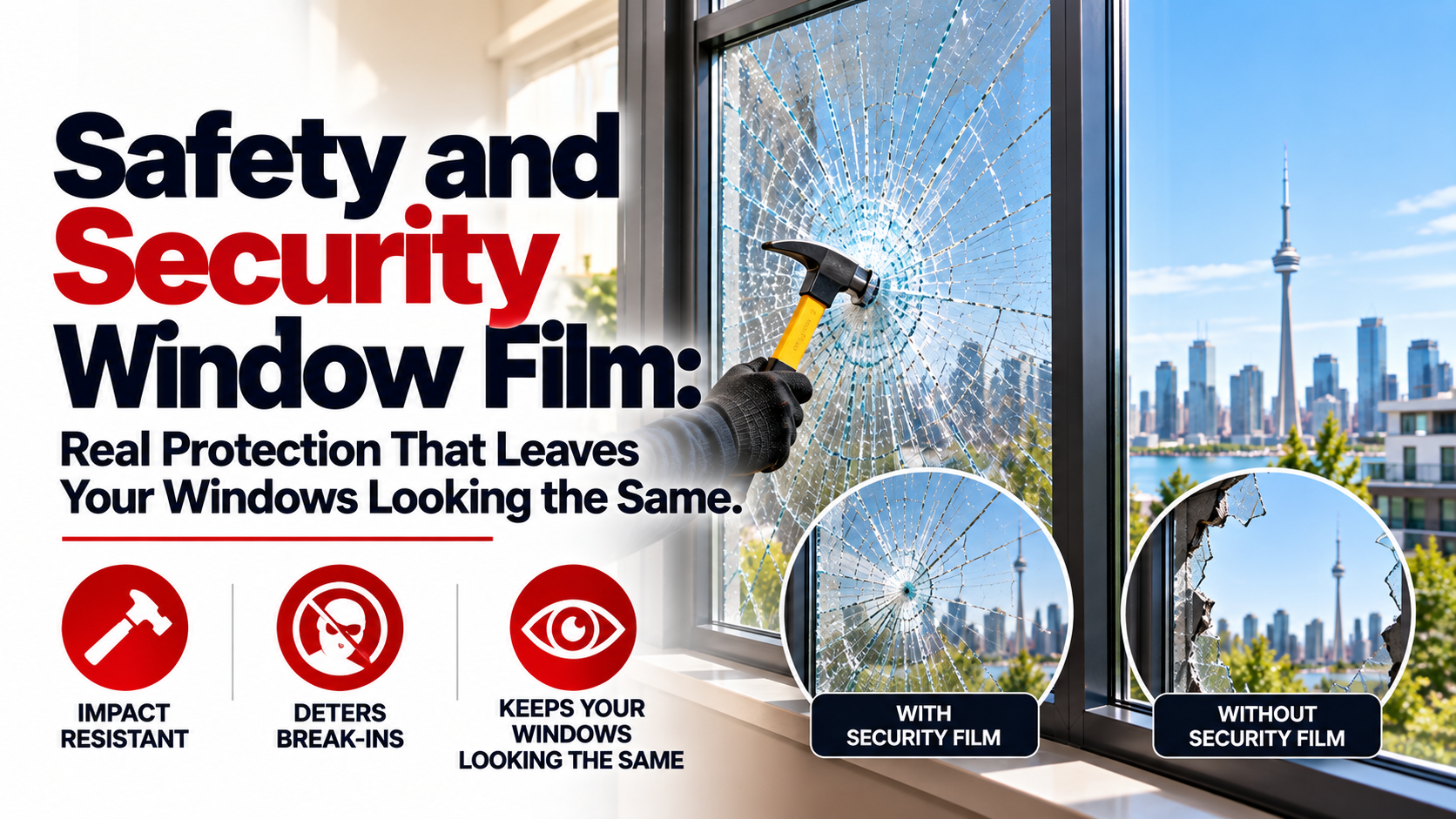









Most window security announces itself. Bars, grilles and roll-down shutters all work by adding hardware that anyone walking past can see. Plenty of homeowners would rather their front windows did not look like a storefront after closing time.
Safety and security window film takes the opposite approach. A thin, clear layer is bonded to the inside of the glass you already have. From the street, the window looks exactly as it did the day before. The difference only shows up when someone tries to break through, and by that point the film is already doing its job.
Why You Stop Noticing the Film Once It Is On
Security film is a polyester laminate thinner than a credit card. It covers only the glass, so your frames, trim and exterior paint stay exactly as they were.
Clear grades let most daylight through without adding any colour. For example, 3M lists a visible light transmittance of 87% for its clear 8-mil safety film, so rooms do not dim. Your view of the yard stays sharp too.
The protection comes from the adhesive. When a filmed pane breaks, the cracked glass stays stuck to the film, much like a damaged windshield that stays in its frame. The International Window Film Association explains that security film holds broken glass in place to delay entry. As a result, anyone trying to get in has to keep striking the same spot. That takes time, and it makes noise.
Five Installation Details That Decide Whether Anyone Notices
Clear film is the easy part. Whether it stays invisible depends on the people installing it, so settle these points before the first pane gets cleaned.
1. Ask for a clear grade by name
Security films are also sold tinted, mirrored and frosted, and each of those changes how your glass looks. If an unchanged appearance is the goal, say so up front and check that the quote names a clear product. On double-pane windows there is a second reason to stay clear: the US Department of Energy cautions that films which mainly absorb solar energy can damage the seals of insulated glass units.
2. Check the edge line
Film is trimmed to stop a hairline short of the frame so it can lie flat. When that gap is narrow and even on all four sides, your eye reads it as part of the glass. On the other hand, wavy cuts, wide margins, lifted corners and trapped specks of dust all catch the light.
3. Plan around window grids
Grilles sealed between double panes leave a flat inner surface, so a single sheet covers the glass. Muntins bonded to the glass are harder. The film has to be cut into each small section, and every extra edge needs to look tidy. Clip-in grilles, meanwhile, can usually come out for the job and go back afterward.
4. Ask where a seam would fall on large glass
Film comes on rolls of limited width, often around five feet. A picture window larger than the roll in both directions therefore needs two pieces joined by a fine, straight seam. Before work starts, ask where that seam will sit. A level seam near the top or bottom of the pane is far easier to miss than one running across your eye line.
5. Know what edge anchoring looks like
On high-risk openings, film can be fixed to the frame with a structural bead or attachment strip for extra strength at the edges. That anchor stays visible as a slim line around the glass, so ask about colours that blend with your frames. You might welcome it on a basement window and skip it on the front bay window.
Where Safety and Security Window Film Needs Backup
Invisibility has one trade-off. Because nobody can see the film, it will not put anyone off before the first swing. Its real value is the delay it creates, and that delay counts most where someone nearby will hear the noise.
A basement window behind a side fence or a back slider screened by hedges gives an intruder cover to keep working. Toronto Police single out sliding glass doors as a favourite target because they are easy to open. They also advise limiting access to hard-to-see windows, low roofs and balconies. At those points, visible hardware earns its place.
Fort Knox Solutions installs window bars, roller shutters and accordion gates as well as film. That way, the street side of your home stays untouched and the visible pieces go where nobody is admiring the view.
Protection for the Hours Your Home Sits Empty
Think about when your house is most likely to be empty: a Sunday at the stadium, a weekend tournament out of town, a late night watching the playoffs at a friend’s place. For fans who plan their weeks around the schedule, The Sports America covers the latest sports news, athlete stories and lifestyle trends. Film cannot stop someone from trying while you are away. What it can do is turn a quick smash into a slow, noisy job that draws attention from the neighbours.
Frequently Asked Questions
1. Will filmed and unfilmed windows look different side by side?
Not in a way most visitors would notice. In bright sun at a sharp angle, you might catch a slightly different sheen. From a normal distance, though, a filmed pane and a bare one look the same.
2. Can film go on textured or frosted glass?
Film needs a smooth surface to bond evenly. Many textured panes have one flat side, and if that side faces the room, the film can usually go there. Have leaded or stained glass checked before committing.
3. Will the film get in the way of blinds, locks or screens?
No. The film sits flat on the glass, so cranks, latches, screens, blinds and sliding tracks work as they did before. Unless you add edge anchoring, nothing touches the frame at all.
4. What does a window look like after a break-in attempt?
Expect crazed, cracked glass still hanging together in the frame rather than an opening someone could climb through. That is the film working. The pane will need replacing, and fresh film goes on the new glass.
5. Can security film be installed in winter?
Yes. The work happens indoors, so snow and cold outside do not stop it. However, cold glass and weak sunlight slow the drying. The light haze that is normal after installation may take longer to clear than it would in summer.