





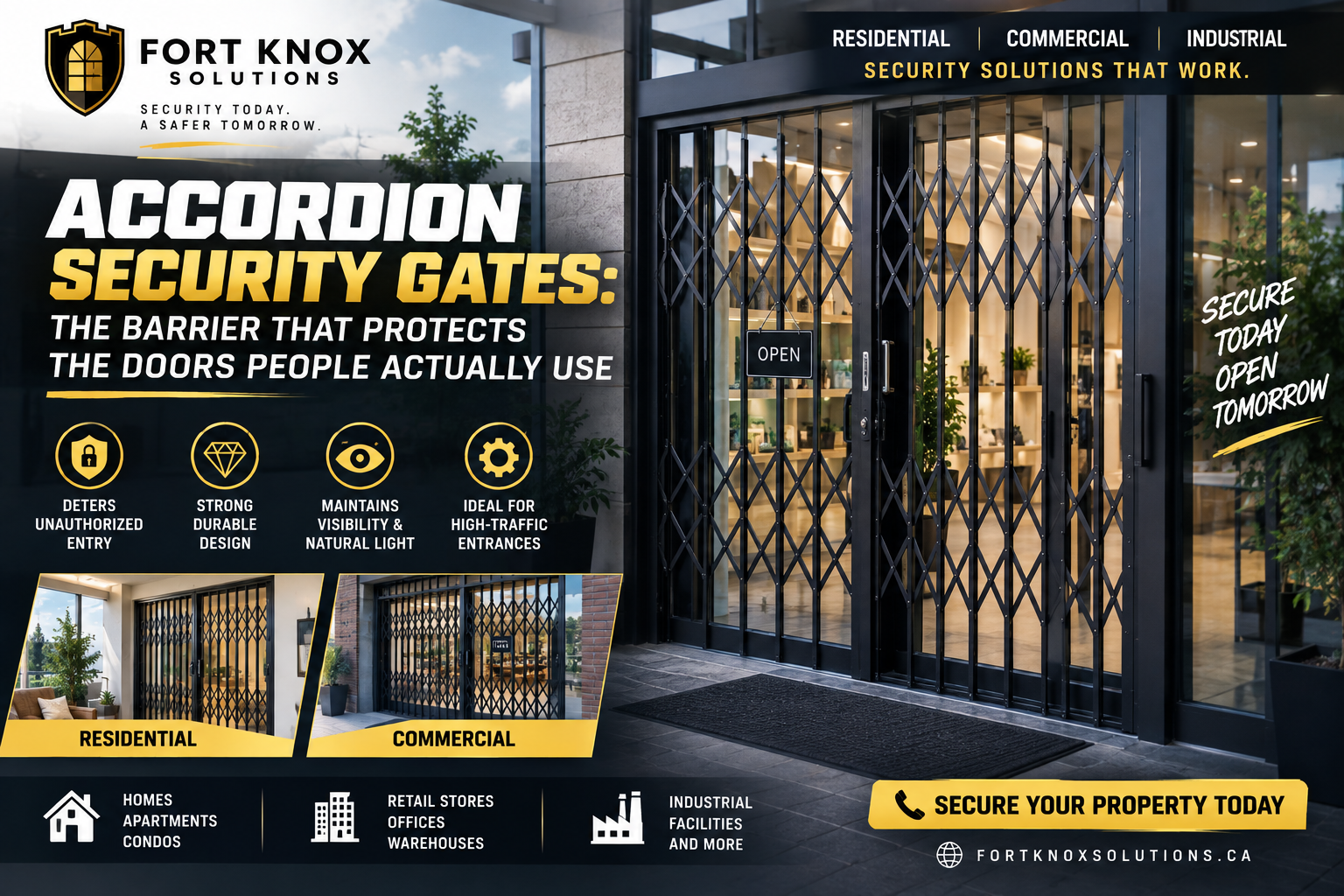




Accordion security gates most security products ask the owner to give something up. Bars mean living behind a grid. Shutters mean a dark room. Boarding up means the shop looks closed even when it is trading.
That trade-off explains an odd pattern in how buildings get protected. The openings used every day, such as the patio door, the side entry and the glass storefront, usually end up with no physical protection at all. Nobody wants to barricade the door they walk through twenty times a week, so they fit a better lock and leave it there.
Accordion security gates exist to solve that specific problem. A folding steel gate locks across the opening when it should be closed and collapses into a few inches at the side of the frame when it should not. The barrier is there without the doorway being lost.
What Is an Accordion Security Gate?
An accordion security gate is a folding metal lattice gate mounted on a track at the top and bottom of an opening. It expands across the doorway or window and locks in place, then folds concertina-style back against the frame when the opening needs to be clear.
The track and frame stay mounted permanently. The gate itself is the moving part, which is what separates it from fixed bars. The protection is present when wanted and out of the way when not.
Operation is manual and key-locking. There is no motor, no wiring and no power draw, which matters more than it first sounds.
One point of clarification, because the terms get mixed up constantly: an accordion gate is an open steel lattice that secures an opening while leaving it visible. Accordion shutters are a solid folding panel system built primarily for storm protection. They share a folding mechanism and almost nothing else. Buying one when you needed the other is a common and expensive mistake.
Why Do Doors and Large Glass Openings Fail First?
A building perimeter is only as strong as its most usable weak point, and usability is the whole problem. A window that never opens can be barred and forgotten. A door that opens forty times a day cannot.
So the openings with the most traffic, such as patio doors, side entries, rear service doors and glass storefronts, end up defended by a lock and a pane of glass. That combination fails to the oldest method there is: break the glass beside the lock, reach through, turn the handle.
A gate changes the shape of that problem. Even with the glass gone, a locked steel lattice anchored into the frame still stands between the outside and the interior. The attempt no longer ends at the glass.
How Does a Gate Protect an Opening That Still Has to Work?
Three properties of the accordion design suit openings in daily use.
It folds completely out of the way
Retracted, the gate stacks into a narrow column at the side of the frame. The doorway is fully usable, the window unobstructed, and nothing has to be lifted, stored or carried away.
It closes in seconds
Pulling a gate across and turning a key is a two-second job. Any protection that takes five minutes to deploy gets skipped on busy nights. This one does not.
It stays open where it needs to
A patio door can be left open for air in July with a locked barrier still across the opening. A storefront can trade all day with the gate folded back and close at 9 p.m. The gate adapts to how the space is actually used rather than dictating it.
How Do Accordion Gates Compare to Bars and Shutters?
These three products get grouped together and they solve different problems. The right choice depends almost entirely on whether the opening is in use.
| Accordion gate | Fixed security bars | Roller shutter | |
| Light and view | Open lattice, so daylight and airflow pass through | Open grid, but permanently in the sightline | Blocks the opening entirely when closed |
| When not in use | Folds back into a few inches at the side of the frame | Stays in place permanently | Rolls up into a housing above the opening |
| Power supply | Manual and key-locking, with no wiring or motor | None needed | Often motorised; manual options exist |
| Best suited to | Openings used daily that must stay accessible | Openings rarely or never used, e.g. basement windows | Full overnight closure and weather cover |
| Everyday use | Opened and closed in seconds by staff or family | Not operated day to day | Closed at end of day, opened at start |
Most properties end up using more than one. Fixed bars suit basement windows nobody opens. Roller shutters suit openings that should be fully closed and covered overnight, and in weather-exposed regions they overlap with storm panels and other hurricane hardware. Accordion gates cover everything in between, meaning the openings that have to stay in service.
Where Do Accordion Gates Make Sense at Home?
Residential use clusters around the openings a standard lock does not cover well.
● Patio and sliding glass doors
The most common application by a distance. Large glass area, ground level, usually facing a private backyard where someone can work unseen. A gate allows the door to stay open in summer and locks the opening when the house is empty.
● Basement entries and walk-outs
Below sightline, out of view from inside the house, and often the least secure door on the property.
● Side and rear entry doors
The doors nobody watches. A side entry behind a fence offers cover to work undisturbed.
● Condo balcony doors
Ground-floor and low-level balconies are reachable more often than residents assume, and a folding gate adds a barrier without any exterior alteration, which usually matters for building approval.
● Ground-floor windows and garage side doors
Both are routine entry points, and both stay fully usable with a gate fitted.
Where Do They Earn Their Keep in a Commercial Property?
For businesses the calculation is different. The glass frontage that sells the product is the same glass that fails in a smash-and-grab, and it cannot be replaced with a wall.
A gate closes that gap after hours while keeping the display visible during the day. Stock stays on show behind steel instead of being cleared into the back every night.
- Retail storefronts, plaza units and mall frontage get overnight cover for glass without hiding the window display.
- Rear and service entrances are the doors most often targeted, because no customer or passerby ever looks at them.
- Clinics, pharmacies and dispensaries hold regulated stock, which makes the premises a specific rather than an opportunistic target.
- Restaurants, cafés and bars combine late closing, cash on site and staff locking up alone.
- Warehouses and loading areas have large openings that need to be fully open by day and fully closed by night.
Gates work inside the building too. Stockrooms, counters, display cases and corridors can be closed off to separate public areas from back-of-house, which matters as much for internal loss as for break-ins.
Why Does “No Power Supply” Matter More Than It Sounds?
Manual operation reads like a limitation next to a motorised shutter. It is closer to an advantage.
- Nothing fails in an outage. A gate that needs electricity stops working during a storm, which is when a property is most exposed and least attended.
- There is no motor to service. No controller, no remote to lose, no wiring to fault, and no maintenance contract attached to the mechanism.
- Installation is simpler and cheaper. No electrician, no power run to the opening, and no permit complications from adding a circuit.
- It works in leased units. Tenants can often fit a manual gate where a wired installation would need landlord approval and reinstatement at the end of the lease.
For a security product, the fewer things that can stop working, the better. A key and a lock have a very short failure list.
What Does “Custom Measured” Actually Change?
This is what separates a gate that works from one that becomes an irritation.
Openings are rarely square, rarely standard, and rarely identical even within the same building. A gate cut to a generic size leaves gaps at the edges, binds in the track, or fouls a handle, a frame return or a threshold. Gaps at the edge are where a barrier gets defeated, and a gate that sticks is a gate people stop closing.
Proper fitting starts with measuring the frame and studying how the space is used day to day, including which way people move through it, what has to stay clear, and where the gate can stack without blocking anything. The finish is then chosen to suit the property rather than announce itself.
Gates can be fitted to existing buildings as well as new construction, so retrofitting is the normal case rather than the exception.
How Do Gates Fit With the Rest of a Security Plan?
A gate is one layer, and layering is the point. Different openings fail in different ways, and each measure should be matched to the weakness it actually solves.
Glass that must stay clear and unobstructed is a job for window security film, which holds a broken pane together rather than putting anything in front of it. That is the same principle applied at scale in this guide to highrise window safety. Frames and strike points, which account for the other half of forced entries, are handled by door reinforcement. Gates cover the openings that need a physical barrier people can still walk through tomorrow morning.
What Should You Check Before Choosing a Gate?
Five questions that decide the specification:
- How often is this opening used? Daily use points to a gate; never-used points to fixed bars.
- Does the opening need to stay visible? Storefronts and display windows usually do; rear doors usually do not.
- Which side can the gate stack on? Furniture, shelving, handles and door swings all affect where it folds back to.
- Who will be closing it, and when? A gate closed by one staff member at midnight needs to be effortless.
- Is the property leased? That affects mounting, finish and what has to be reinstated later.
Frequently Asked Questions
1. What is an accordion security gate?
A folding metal lattice gate that expands across a door or window opening and locks in place, then folds back against the side of the frame when the opening needs to be clear.
2. Do accordion gates block light or airflow?
No. The lattice is open, so daylight and air pass through and you can still see out. That is why they suit doors meant to stay open in warmer months.
3. What is the difference between an accordion gate and an accordion shutter?
A gate is an open steel lattice built to secure an opening while keeping it visible. A shutter is a solid folding panel built mainly for storm protection. They share a folding mechanism and little else.
4. Can they be fitted to an existing door or window?
Yes. Gates are installed on existing buildings as well as new construction, and each one is measured to the specific opening rather than supplied in fixed sizes.
5. Do they need power or wiring?
No. Operation is manual and key-locking, with no motor, controller or power supply, which means the gate still works during an outage.
6. Can accordion gates be used on both homes and businesses?
Yes. Residential applications include patio doors, basement entries and side doors. Commercial applications include storefronts, rear entrances, stockrooms and interior corridors.
7. Do they work alongside other security products?
They do. Gates are commonly paired with window security film, door reinforcement and security bars so each opening is covered by whichever measure suits it.
The Takeaway
The doors and windows used most are the ones most likely to have no physical protection at all, because every other option gets in the way. A folding gate is the exception: locked when you want it, gone when you do not.
Fort Knox Solutions custom-fits accordion security gates for homes and businesses across Vaughan, Toronto and the wider GTA, and offers a free on-site quote to measure and assess individual openings. More practical property protection guides are collected in the service section.