









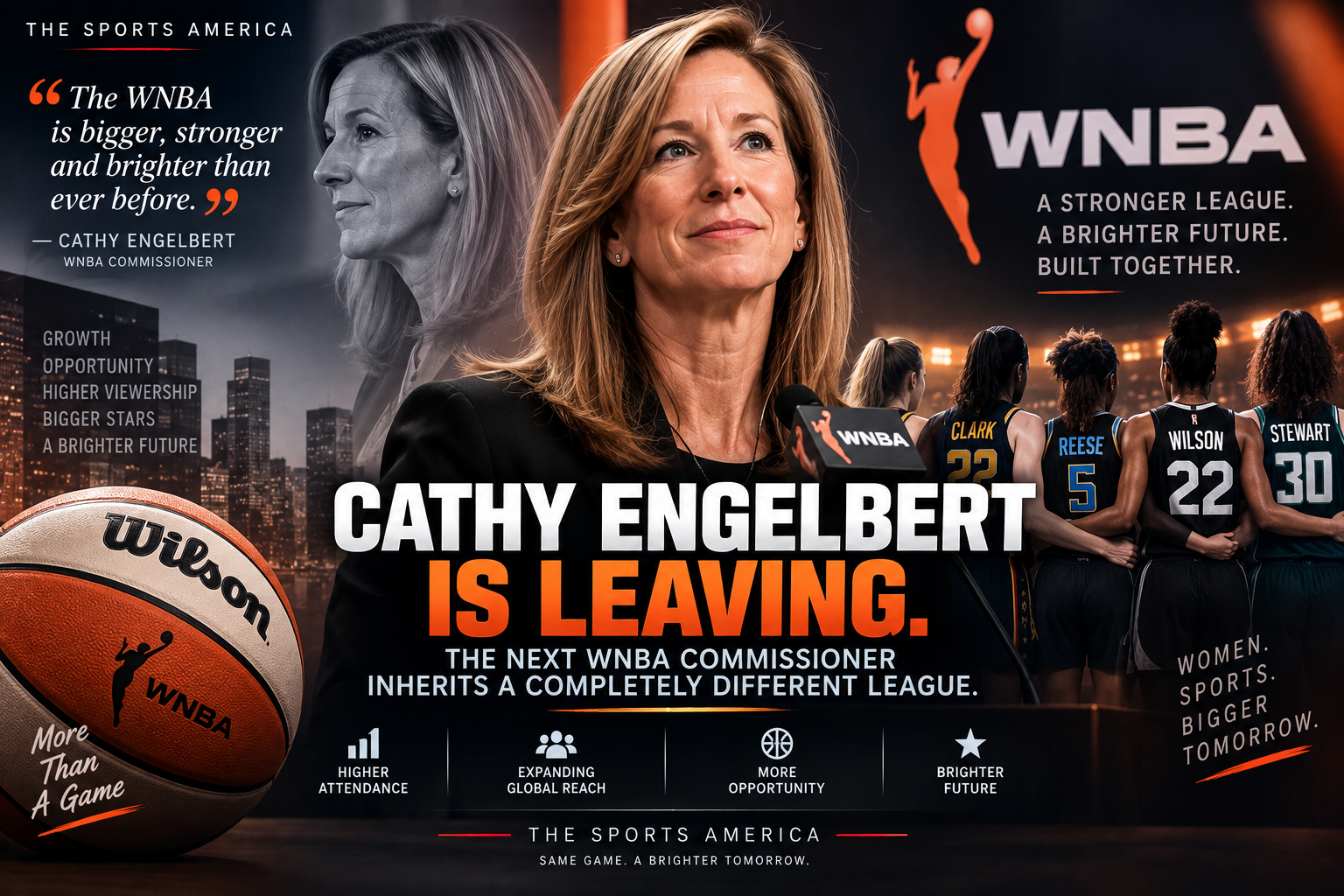
When Cathy Engelbert took the job in 2019, the average WNBA franchise value was about $10 million. Today it is roughly $460 million.
That single comparison explains why the league announced her retirement on Friday with a statement from NBA commissioner Adam Silver calling it the most significant period of growth in the WNBA’s 30-year history. With Cathy Engelbert retiring at the end of the year, finding the next WNBA commissioner becomes one of the more consequential hires in American sports.
Cathy Engelbert retiring takes effect at the end of this year, closing out seven and a half seasons as the league’s first commissioner. She told the Associated Press she originally intended to do the job for three and a half.
The record is genuinely hard to argue with
Engelbert came to the WNBA from Deloitte, where she was CEO. That background shaped almost everything about her tenure, for better and worse.
The wins are concrete. Charter travel for players, which the league resisted for years on cost grounds, became standard. The 2020 season happened at all, played in a bubble at IMG Academy in Bradenton, when plenty of leagues that size simply cancelled. A media rights deal worth more than $2 billion was negotiated. A collective bargaining agreement produced the first million-dollar player salaries in league history.
And WNBA expansion 2030 is the number that will define the era. The league is going from 12 teams to 18 by the end of the decade. That is a 50% increase in franchises in a league that spent its first two decades contracting and relocating.
Viewership, attendance, League Pass subscriptions, merchandise and corporate partnership revenue all set records on her watch. WNBPA president Nneka Ogwumike, whose union has clashed with the league office repeatedly, still credited Engelbert with championing growth initiatives and driving historic expansion as franchise values climbed.
The friction was real too
Engelbert leaves with a reputation among players that does not match the balance sheet.
She formally apologized to players in 2024 for failing to sufficiently condemn hate speech directed at the league during a CNBC appearance. Officiating complaints have been a constant. Before the current CBA, salaries and travel accommodations were a recurring source of anger. Players have described a sharp rise in online abuse over the past few seasons and have said publicly that the league has not done enough to protect them.
Most recently, the debate over transgender player eligibility has made the WNBA a lightning rod, at times drowning out the basketball being played during the 2026 season.
Engelbert insisted the decision to leave was entirely her own and that she faced no pressure to step down. She framed the timing around the league’s financial transformation being far enough along to hand off cleanly. Silver had praised her work in public while declining to commit to her future, and Engelbert had been similarly noncommittal when asked directly at July’s All-Star Game in Chicago.
Read those two facts together and you get a fairly clear picture of how the last twelve months went.
What the next WNBA commissioner actually inherits
The next WNBA commissioner does not need to prove the league is a viable business. That question is settled. They inherit a different and harder set of problems.
Absorbing six new franchises without diluting the product. Expansion at this pace stretches talent thin. Every new team means roster spots filled by players who would not have made a 12-team league. Managing that transition while the product is at peak visibility is the central operational challenge of the next five years.
Fixing the relationship with the players. The CBA improved the economics. It did not fix the trust gap. A commissioner who arrives without Engelbert’s history has a window to reset that, and it will not stay open long.
Officiating. It sounds minor next to media rights and expansion. It is not. Officiating complaints are the single most consistent player criticism across the entire Engelbert era, and they have never been meaningfully addressed.
Deciding what the league is willing to say. The eligibility debate, the online abuse, the political attention that comes with being the most visible women’s league in the country. Engelbert’s instinct was corporate caution. Whether that remains the right posture is now an open question for whoever is next.
The timing is not accidental
Engelbert is leaving in the same week that the FIBA Women’s World Cup opened in Berlin with Caitlin Clark, Paige Bueckers and Angel Reese all making their debuts for Team USA, and with the WNBA on a three-week competition break to accommodate it.
That is a useful snapshot of where the league sits. Its biggest stars are global draws. Its calendar now bends around international basketball. Its rookies arrive with audiences already attached to them from college.
None of that was true in 2019. Engelbert’s central achievement is that she was in the chair when the sport’s commercial value caught up to its quality, and she moved fast enough to capture it through media rights, expansion and a CBA rather than letting the moment pass.
Her critics would argue the moment arrived largely because of the players and that the league office spent years reacting rather than leading. Both things can be true, and the honest verdict on her tenure probably lives somewhere between them.
The structural catch nobody mentions
The WNBA was founded 30 years ago as a subsidiary of the NBA, which remains a significant investor. Engelbert and the WNBA leadership reported to that structure.
So will her successor. Any conversation about the next commissioner’s independence runs into that fact, and the search itself will be run out of the same offices.
There is a case that the league has now outgrown the arrangement. A WNBA franchise value approaching half a billion dollars, an 18-team footprint by 2030 and a $2 billion-plus media deal describe a business that could stand on its own. Whether the NBA sees it that way is a separate matter entirely.
Engelbert turns 62 in November. She said she retires believing the league built something more durable than she imagined possible in 2019. On the numbers, she is right.
The harder question is whether the next person can hold that growth together while fixing the parts of the league that money did not fix.
Source links for editors
- https://www.wnba.com/news/commissioner-cathy-engelbert-to-retire-at-end-of-year
- https://www.sportico.com/leagues/basketball/2026/wnba-commissioner-cathy-engelbert-retiring-1234944049/
- https://www.cbsnews.com/news/wnba-commissioner-cathy-engelbert-retire/
- https://bleacherreport.com/articles/25496056-cathy-engelbert-retire-wnba-commissioner-end-2026