


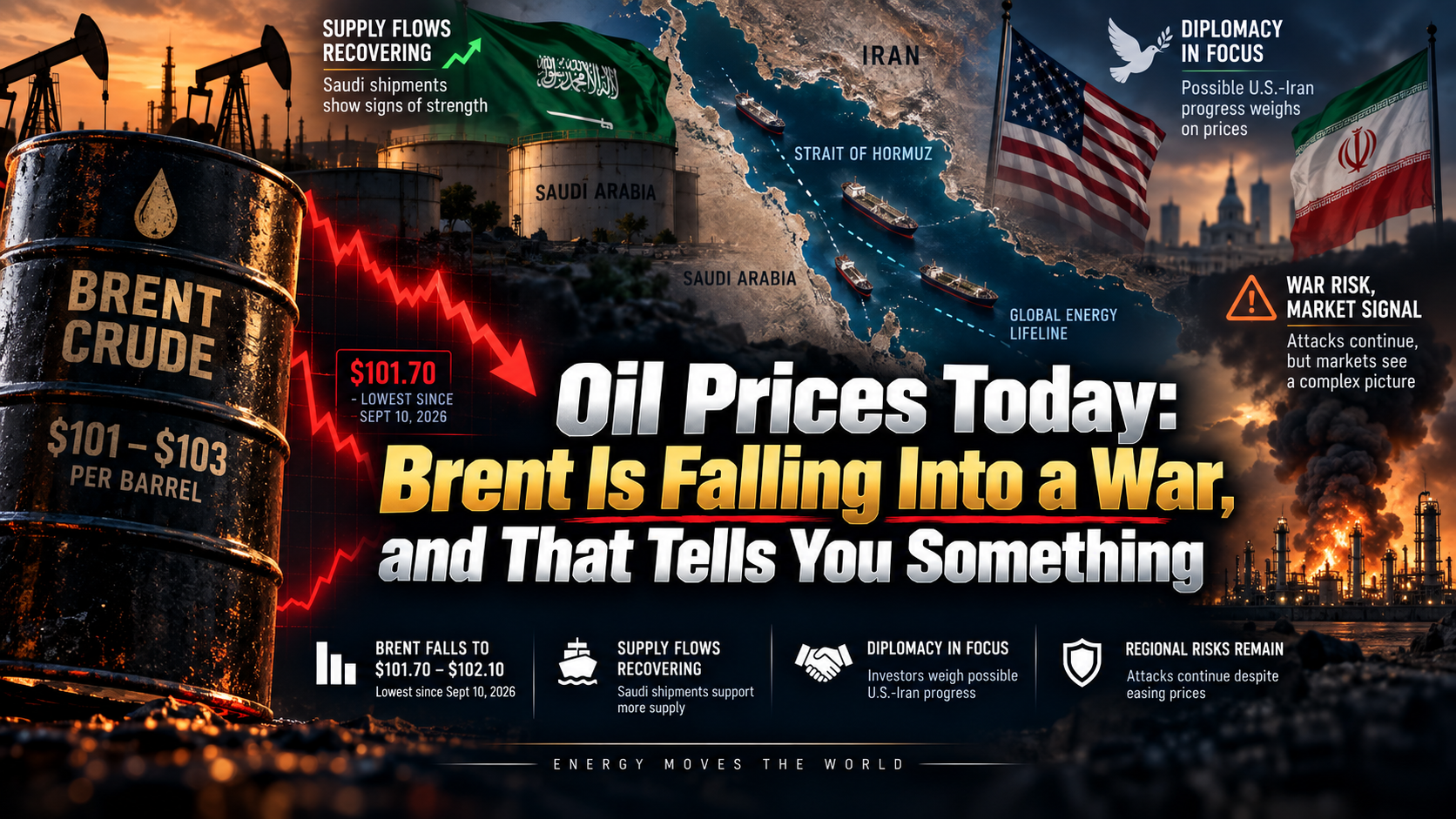






On Saturday, Iran-backed Houthi forces fired missiles and drones at Saudi Arabia. Riyadh issued air-raid alerts for the first time since the height of the US-Iran war in the spring, and warnings went out across Red Sea hubs including Yanbu. By any normal reading of an oil market, crude should have gapped higher on Monday.Oil prices today extended a decline that is now in its fourth session, the longest losing run since June. Brent for November delivery dropped 1.71% to $102.09 a barrel while West Texas Intermediate for October fell 1.96% to $98.33. That is a market telling you something, and what it is telling you is that traders have stopped pricing escalation and started pricing an exit.
Why oil prices today are falling into a war
The simplest explanation is diplomacy.
President Trump told Fox News he would “probably” be open to meeting Iranian President Masoud Pezeshkian on the sidelines of the UN General Assembly in New York this week. He is also holding a summit with Xi Jinping and may meet Gulf leaders. None of that constitutes a deal. All of it constitutes a meaningful change in tone from a conflict that has driven energy markets for most of 2026.
The second explanation is that supply has held up far better than the headlines suggest. Admiral Brad Cooper, head of US Central Command, said crude and liquefied natural gas flows through the Strait of Hormuz over the past two weeks are running at a six-month high. JPMorgan analysts noted in a 18 September client note that Middle East oil flows have remained surprisingly strong despite the disruption to Saudi Arabia’s East-West pipeline.
That pipeline matters enormously. It was shut down on 11 September after strikes by Iran-affiliated forces, removing the ability to route roughly seven million barrels per day to the Red Sea as an alternative to the blockaded Persian Gulf. Saudi Aramco has since indicated it expects to restore a significant share of those flows, and has been telling refining customers what to expect. The market has taken that guidance at face value.
The scale of what the market is shrugging off
It is worth stating plainly how unusual the current supply situation is, because the falling price obscures it.
The International Energy Agency has characterised the disruption from the Strait of Hormuz and Bab al-Mandab crises as the largest supply disruption in the history of the global oil market. Saudi production recently fell to its lowest level since 1990. The US Strategic Petroleum Reserve sits near a record low. Aramco has told at least two European refining customers they will receive no crude next month.
Against that, Brent is trading near $102 rather than the $147.50 all-time high set in July 2008, or even the $118 peak it touched in late March this year. The price has been volatile rather than parabolic: roughly $70 by the start of July, back above $100 by late July, fluctuating between $87 and $97 through August, then up to $109 in early September and a four-month high of $106 last Tuesday before this week’s slide.
That pattern is not a market in panic. It is a market that has spent six months learning how much disruption the system can absorb, and repeatedly concluding the answer is “more than we thought.”
What cheaper oil means beyond the pump
For inflation and interest rates
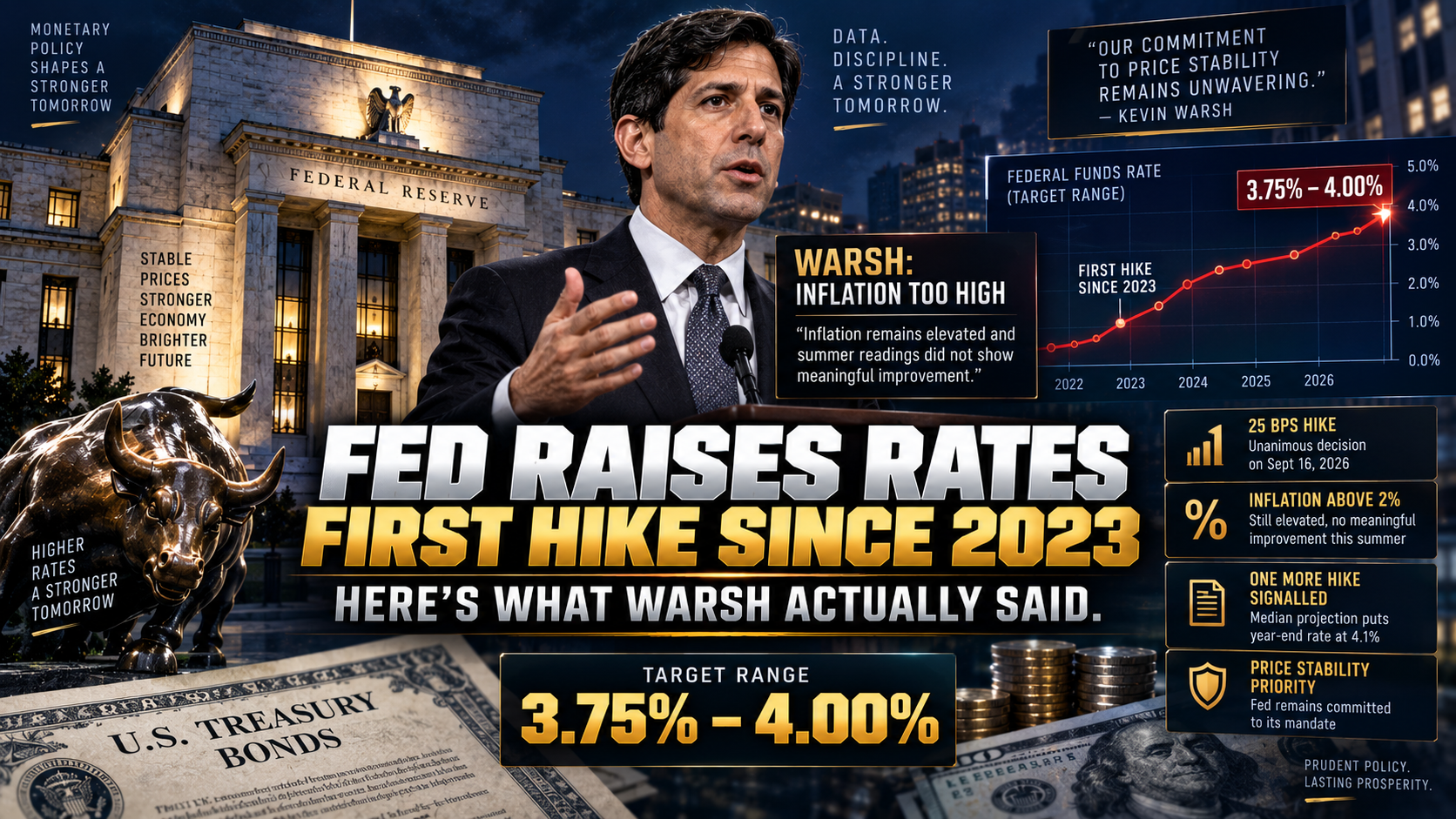
This is the connection most people miss. The Federal Reserve raised interest rates last Wednesday for the first time since July 2023, taking the federal funds target to 3.75%-4%. Chairman Kevin Warsh was explicit that the inflation forcing his hand has been driven substantially by energy prices.
He was equally explicit that the Fed cannot solve an oil shock. What it can do is prevent that shock from broadening into general price pressure, which is what the hike was designed to achieve. So every session that oil prices today spend falling weakens the case for the additional hike that sixteen of eighteen FOMC officials currently expect before year-end.
Traders currently put the odds of another increase at around 87%. A sustained move below $100 would start eroding that number.
For the American consumer
Diesel above $6 a gallon has been one of the defining economic facts of 2026, and inflation has been stuck near 3.4%. With midterm elections in November, the political salience of fuel prices is about as high as it gets. That is part of why the administration’s posture has softened toward talks.
For refiners and exporters
China exported 6.01 million tonnes of refined fuels in August, up 12.7% year on year, with jet fuel exports hitting a record high. Chinese and South Korean refiners have picked up most of the volume still moving through Hormuz. Further easing of Chinese export controls would let those refiners capture stronger overseas margins, which would add supply to a product market that has been tighter than the crude market all year.
What it means at the pump and along the supply chain
The retail consequences of this year’s energy shock have been severe and are only partially reflected in the futures price.
Diesel has been running above $6 a gallon in the United States, which feeds directly into freight costs and therefore into the price of almost everything that moves by road. Headline inflation has been stuck near 3.4%. With midterm elections in November, that combination has made fuel prices one of the most politically charged numbers in the country.
Shipping economics have been reshaped as well. With Persian Gulf tanker traffic constrained and Red Sea routes threatened, voyage lengths have extended and insurance premiums have risen sharply. A supertanker shortage now threatens long-haul crude flows, which adds cost even when the barrels themselves are available. That is a structural drag that persists after the headline price falls, because charter rates and insurance reprice on a slower cycle than crude does.
Fertiliser costs, which track natural gas, have driven food security concerns in several import-dependent economies since the spring. Airlines have absorbed record jet fuel prices, with Chinese jet fuel exports reaching an all-time high in August as regional refiners captured the margin.
None of that unwinds on a four-day slide in Brent. The point is worth making because a falling futures price generates headlines that suggest relief is arriving at the checkout. In practice, the pass-through from crude to pump and from pump to shelf runs on a lag of weeks to months, and the pass-through downward is historically slower than the pass-through upward.
What would reverse this
Three things would put oil prices today straight back above $106.
A failed diplomatic overture. If the UN General Assembly week ends without any US-Iran contact, or with public escalation, the risk premium returns within hours. Trump has already said the US could re-escalate attacks if dialogue does not restore maritime exports.
A successful strike on Saudi infrastructure. Saturday’s attacks prompted alerts but not reported damage. A hit on export infrastructure, particularly at Yanbu or on the East-West pipeline’s repaired sections, changes the supply maths immediately.
An OPEC+ reversal. The prolonged halt in tanker flows has already forced major OPEC members to cut production. Any signal that those cuts are becoming structural rather than circumstantial would tighten the forward curve.
The honest read
Nothing about the underlying supply picture improved this weekend. Hormuz is still constrained. Saudi output is still near a 35-year low. A pipeline that carries seven million barrels per day is still only partially operational, and Houthi forces demonstrated on Saturday that they retain both the capability and the willingness to strike the kingdom directly.
What changed is expectation. The market has decided that the probability of negotiated de-escalation is higher this week than it was last week, and it has repriced accordingly. That is a legitimate thing for a market to do. It is also, historically, the kind of judgment that gets revised violently.
For anyone watching this for its knock-on effects on inflation, on Fed policy, on the equity rally that is currently leaning on falling energy costs the useful posture is scepticism about the trend rather than the level. A fourth consecutive down day is real. A fifth would start to look like conviction. Anything above $106 means the last week never happened.
Track the oil prices today narrative through the UN General Assembly and the 24 September summit, because both fall inside a five-day window that will determine whether this is the start of normalisation or another false dawn in a market that has produced several already this year.
