







The Dow has now lost ground for three consecutive weeks. It fell 1.7% over the last five sessions alone, its worst run since March. And yet on Monday morning, futures across all three major indices were pointing higher.That contradiction is the whole story of the stock market today. Investors are not buying because conditions improved. They are buying because two specific pressures oil and bond yields eased at the same moment, and because a summit that could have gone badly now looks like it will merely go quietly.
Where the stock market today opened
S&P 500 futures rose 0.6% and Nasdaq 100 contracts climbed 0.8% in pre-market trading, with Dow futures up around 0.7%. Technology led the advance across Asian, European and US markets. Treasuries rallied across the curve, with European government bonds outperforming. The dollar traded flat.
The context matters more than the percentages. Last week the S&P 500 finished roughly unchanged, down about 0.1%. The Nasdaq managed a 0.7% gain on the back of continued AI enthusiasm. The Dow did the damage, sliding 1.7% as rate-sensitive and industrial names absorbed the reality of a central bank that has started tightening again.
By Friday’s close the S&P 500 sat at 7,650.50 and the Dow at 51,683, with the ten-year Treasury yield having pushed back toward 5.00%. That yield is the single most important number on the screen right now, and it explains almost everything about sector rotation this month.
The two things that changed over the weekend
Oil finally broke
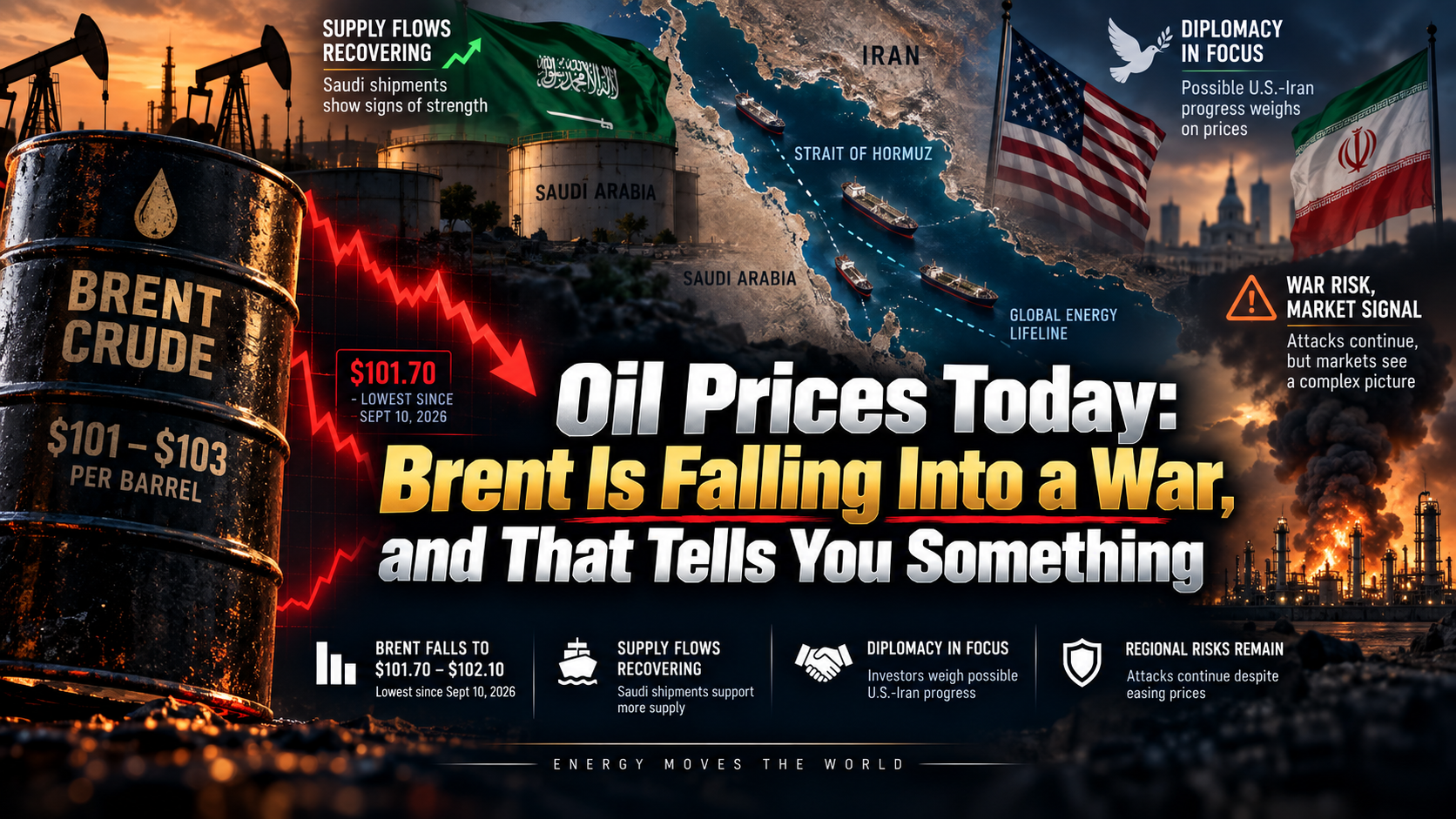
Brent crude fell for a fourth consecutive session, its longest losing streak since June, trading near $102 a barrel while West Texas Intermediate slipped below $100. That came despite Iran-backed Houthi forces launching missile and drone attacks on Saudi Arabia on Saturday, which prompted air-raid alerts in Riyadh for the first time since the spring.
Markets looked past it, and the reason is diplomacy. President Trump told Fox News he would “probably” be open to meeting Iranian President Masoud Pezeshkian on the sidelines of the UN General Assembly this week. Meanwhile, US Central Command reported that crude and LNG flows through the Strait of Hormuz over the past fortnight are running at a six-month high.
Cheaper energy matters to equities for a mechanical reason. Oil has been the primary driver of the inflation that forced the Federal Reserve to raise rates last week. Every dollar off the barrel weakens the case for further tightening.
Bond yields softened
Treasuries rallied globally on Monday, easing the discount-rate pressure that has been squeezing high-multiple growth names all month. When the ten-year backs away from 5%, the valuation maths on long-duration technology stocks improves immediately. That is why the Nasdaq is outperforming rather than the Dow, and why the rally is narrow rather than broad.
What the stock market today is still worried about
Three overhangs have not gone anywhere.
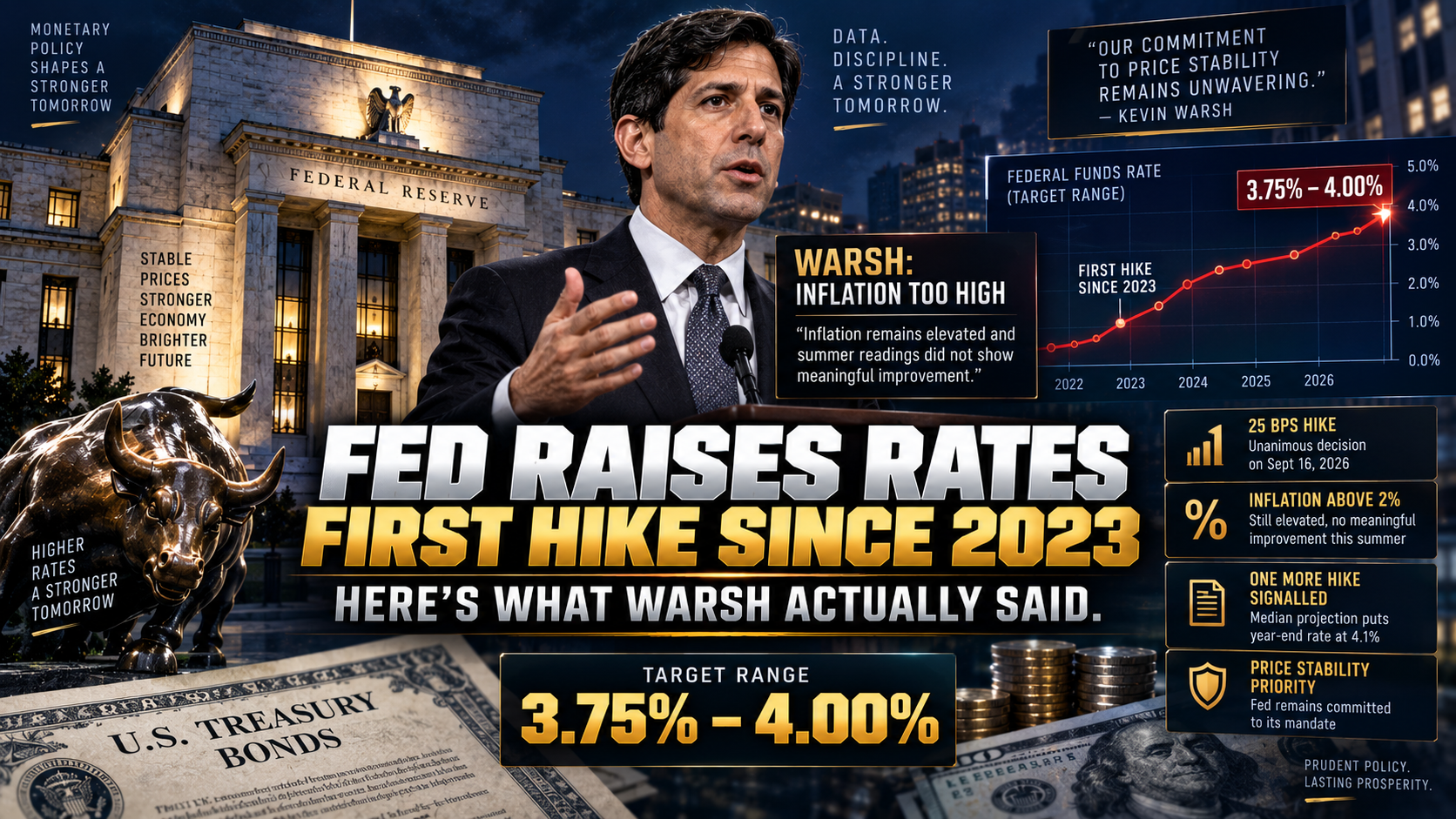
The Fed is tightening, not easing. Last Wednesday the FOMC voted unanimously to lift the federal funds target to 3.75%-4%, the first increase since July 2023. The dot plot showed sixteen of eighteen officials expecting at least one more hike before year-end. Traders now put the odds of another increase at roughly 87%. This is not a backdrop that historically supports multiple expansion.
Middle East risk has not been resolved, only deferred. The Saudi East-West pipeline has been offline since 11 September. Saudi output recently fell to its lowest level since 1990. The US Strategic Petroleum Reserve sits near a record low. Any of those facts can reassert itself within a session.
AI valuations are stretched and increasingly debated. The sector carrying the index higher is also the one generating the loudest scepticism. Chip stocks have wobbled on commentary about development pauses, insider selling and rising memory costs, even as fundamental demand remains extraordinary.
The week ahead is thin, and that cuts both ways
The economic calendar is unusually light. Monday brings the Chicago Fed National Activity Index and remarks from Chicago Fed President Austan Goolsbee. Earnings are sparse.
A quiet calendar removes the risk of a nasty data surprise. It also removes the catalysts that would justify a sustained move higher. In practice, that tends to mean the tape follows the news flow rather than the fundamentals, and this week the news flow is dominated by two things happening in Washington and New York.
The first is the Trump-Xi summit on 24 September, with groundwork talks between Treasury Secretary Scott Bessent and Vice Premier He Lifeng having opened in New York on Sunday. The central question is whether last year’s trade truce gets extended. Markets are treating a straightforward extension as the base case, which means the risk is asymmetric: little upside if it happens, real downside if it does not.
The second is the UN General Assembly, where any signal on US-Iran talks will move energy markets and therefore everything else.
How to read the stock market today if you are not trading it
For anyone with a longer horizon, the useful observations are structural rather than tactical.
Firstly, the market has spent this month rotating, not falling. Money has moved out of rate-sensitive industrials and defensives and into technology. The Dow’s three-week slide alongside a positive Nasdaq is the clearest possible illustration.
Secondly, the inflation problem driving Fed policy is energy-led rather than demand-led. That is a genuinely different situation from 2022. A central bank cannot produce more crude, which is why Chairman Kevin Warsh has been careful to frame policy as preventing price shocks from broadening rather than reversing them.
Thirdly, the labour market is not cracking. August payrolls came in at 162,000 against expectations of 53,000, and unemployment held at 4.1%. That resilience is what gives the Fed room to focus on inflation, and it is also why recession positioning has been a losing trade this year.
Where the money is actually going
The index level tells you almost nothing this month. The rotation tells you everything.
Technology and semiconductors are absorbing the inflows. Nvidia guided to a 70% revenue increase for next fiscal year, an unusual move for a company that normally issues quarterly projections only, and chief executive Jensen Huang has said he expects the company to sell twice as many chips next year. Hyperscaler capital expenditure keeps rising. That is a genuine earnings story rather than a sentiment story, which is why the Nasdaq has held up while the Dow has not.
Industrials and rate-sensitive names are bearing the cost. The Dow’s constituents skew toward businesses that finance inventory, equipment and long-cycle projects, all of which get more expensive when the funds rate rises. Losses last week were led by IBM, Disney and Nike.
Energy is the swing factor in both directions. Crude above $100 supports energy equities while simultaneously feeding the inflation that forces further tightening. Falling crude does the reverse. There is no version of this where energy prices are neutral.
Defensives have quietly underperformed during the current bounce, with consumer staples, communications and utilities all softer. That is the signature of a risk-on session rather than a flight to quality, and it is a useful confirmation that Monday’s move was about positioning rather than fear.
The concentration risk in that picture is obvious. A market where a handful of megacap technology names determine the direction of the whole index is structurally fragile, regardless of how good those businesses are. Breadth, not the headline number, is the thing to monitor from here.
The levels that matter
Watch the ten-year yield. A sustained move back below 4.8% would broaden this rally beyond technology. A push through 5.1% would do the opposite and put pressure on the whole complex.
Watch Brent. A fifth consecutive down day would confirm that the market genuinely believes in the diplomatic track. A reversal above $106, the four-month high set last Tuesday, would reprice the inflation outlook and, by extension, the Fed’s December meeting.
And watch the breadth. A rally carried by four or five megacap names is a fragile thing. If the advance-decline line improves alongside the index, this is a recovery. If it does not, it is a rotation wearing a recovery’s clothes.
The stock market today is calmer than it was on Friday. That is worth acknowledging without mistaking it for a resolution. Nothing that caused three straight weekly losses on the Dow has actually been fixed. Two of the symptoms simply stopped hurting for a morning.
