








Jayden Daniels Dislocated the Same Elbow Again. Washington’s Season Just Changed Shape.
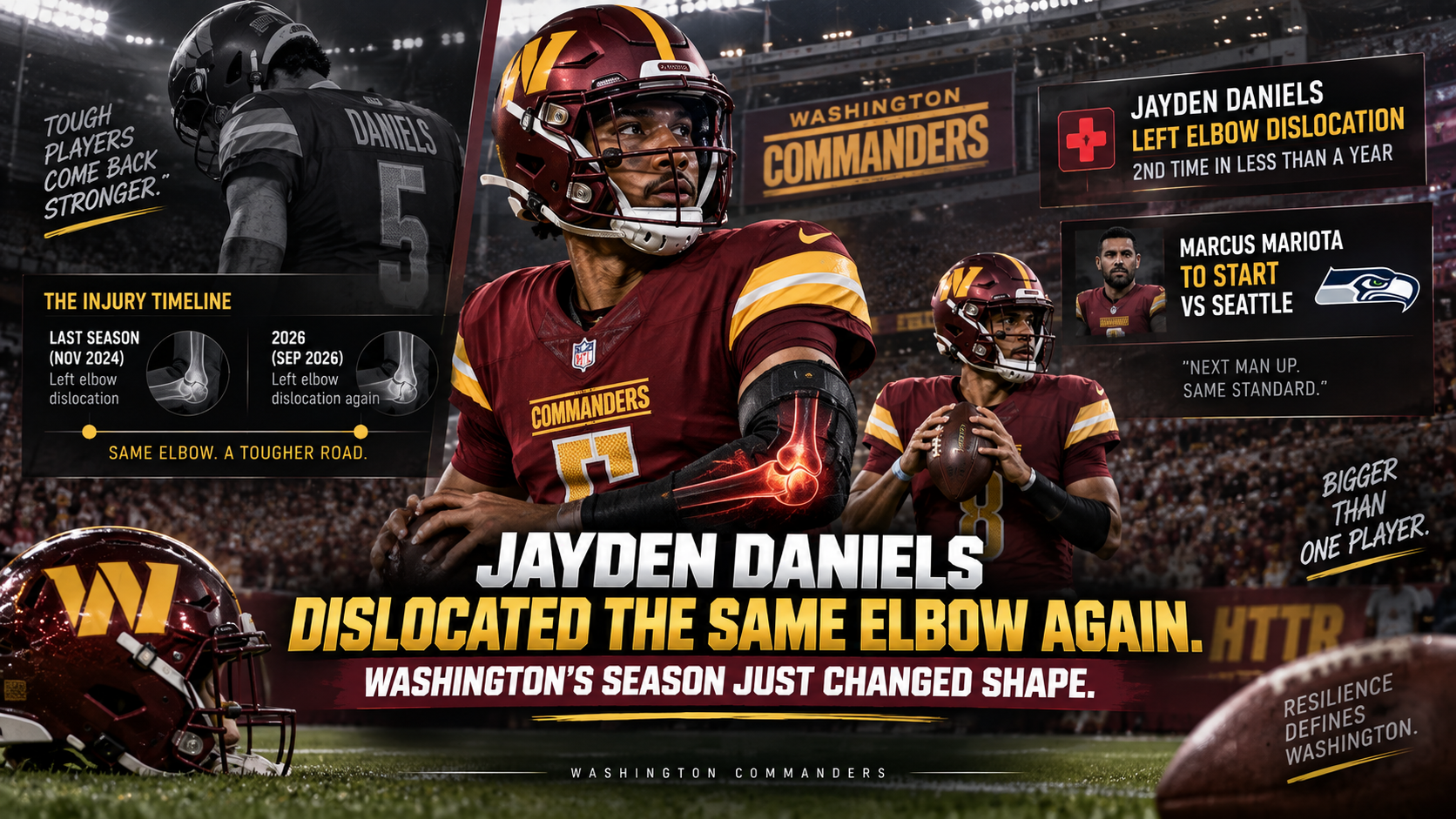
Three seconds remained in the first half at AT&T Stadium. Washington had the ball on the Dallas one-yard line, trailing 17-10, and Dan Quinn waved off the field goal unit. It was an aggressive call from a coach whose team had just clawed back from 17-3 down. It was also, in hindsight, the play that may have decided the Commanders’ season.Jayden Daniels took the snap from under center. Left guard Chris Paul stepped on his back foot as he dropped. Daniels stumbled, threw out his left arm to break the fall, and the elbow gave way beneath him. He got rid of the ball, incomplete, and then stayed down. The Jayden Daniels injury update that followed was short and grim. Washington’s quarterback was carted off with his arm in an air cast and a towel over his head. After the game, Quinn confirmed a dislocated left elbow and said X-rays showed no fracture, with Daniels flying home to undergo further testing on Monday. Dallas won 37-20. Nobody in the visiting locker room was talking about the scoreline. Why this Jayden Daniels injury update is worse than “no fracture” sounds A clean X-ray reads like good news. In this case it mostly tells you what did not happen. The problem is the word “again.” Daniels dislocated the same left elbow in Week 9 of last season, against Seattle, in a 38-14 defeat. He missed four games. He then reaggravated it in his first game back while trying to make a tackle after an interception, and did not play again that year. All told, he appeared in seven games in his second NFL season after a rookie campaign that won him Offensive Rookie of the Year and took Washington to the NFC Championship Game. Repeat dislocations behave differently from first-time ones. The original injury stretches or tears the ligaments that hold the joint together, and those structures heal looser than they started. A joint that has come out once comes out more easily the second time, usually with less force. That is why the mechanism here looked so innocuous: a lineman’s foot, a stumble, an arm put down to break a fall. Nothing about that sequence should dislocate a healthy elbow. So the encouraging reading of this Jayden Daniels injury update — no break, joint reduced, tests to follow — needs a caveat. The relevant question is not whether the bone is intact. It is whether the ligaments have anything left to hold, and whether Washington is now looking at a surgical repair rather than another four-week absence. He was playing the best half of his season The cruelty is in the timing. Daniels had been excellent. Before the injury he was 11-of-17 for 96 yards and a touchdown, with seven carries for 69 rushing yards and no interceptions. More importantly, he was playing the way the coaching staff has spent two years asking him to play. He was sliding when plays broke down. Daniel was taking what the defense gave him rather than hunting the explosive throw. He was not absorbing unnecessary contact. Washington had been down 10-0 and then 17-3. Daniels brought them back almost single-handedly, capping the drive that mattered with a four-yard touchdown pass to Stefon Diggs after rookie kicker Drew Stevens had converted from 27 yards. On the Fox broadcast, Tom Brady watched the replay of the injury and audibly swore before apologising on air. That is roughly the reaction the play deserved. There is an uncomfortable irony in it. The injury did not come from Daniels being reckless. It came from a snap under center on a play call designed to steal seven points before the break. He did everything the staff wanted. The joint gave out anyway. What Washington actually does now Quinn will not have a timeline until Monday’s imaging comes back, and the range of outcomes is wide. A straightforward dislocation with no significant new ligament damage might cost four to six weeks, which is roughly what happened last November. A repair that requires surgery ends the season. Either way, the Commanders are 0-2 and about to find out how much of their offense was scheme and how much of it was Daniels. The quarterback room Washington has spent two years building an offense around a quarterback whose value is inseparable from his legs. Sixty-nine rushing yards in a half is not a bonus; it is a structural feature. Defenses have to account for the quarterback as a runner, which changes gap responsibilities, which is why the play-action game has worked. Take that away and the same play calls produce different pictures. Whoever starts will be operating a version of the offense that was not designed for him. The coaching staff’s first job this week is not motivational. It is deciding how much of the playbook survives. The schedule Washington hosts Seattle in Week 3 as a six-point underdog, which was a reasonable line before Sunday and will move further once the market prices in the quarterback change. An 0-3 start with an uncertain timeline at the game’s most important position is the kind of hole that reframes a season in September. That matters more than it normally would, because the NFC East is not soft. Dallas just put up 37 points behind a Dak Prescott performance that produced 26-of-31 passing, 279 yards and four touchdowns, one of which moved him past Tony Romo for the most touchdown passes in franchise history. The Giants beat the Cowboys in Week 1. Philadelphia keeps finding ways to win close games. Nobody in this division is going to wait for Washington to get healthy. The question the organisation has to answer There is a version of this conversation that turns into criticism of Daniels’ playing style, and it is mostly wrong. Daniel was not scrambling when this happened. He was not lowering his shoulder. He was standing in the pocket on a designed pass, and a teammate stepped on his foot. You cannot coach that…