
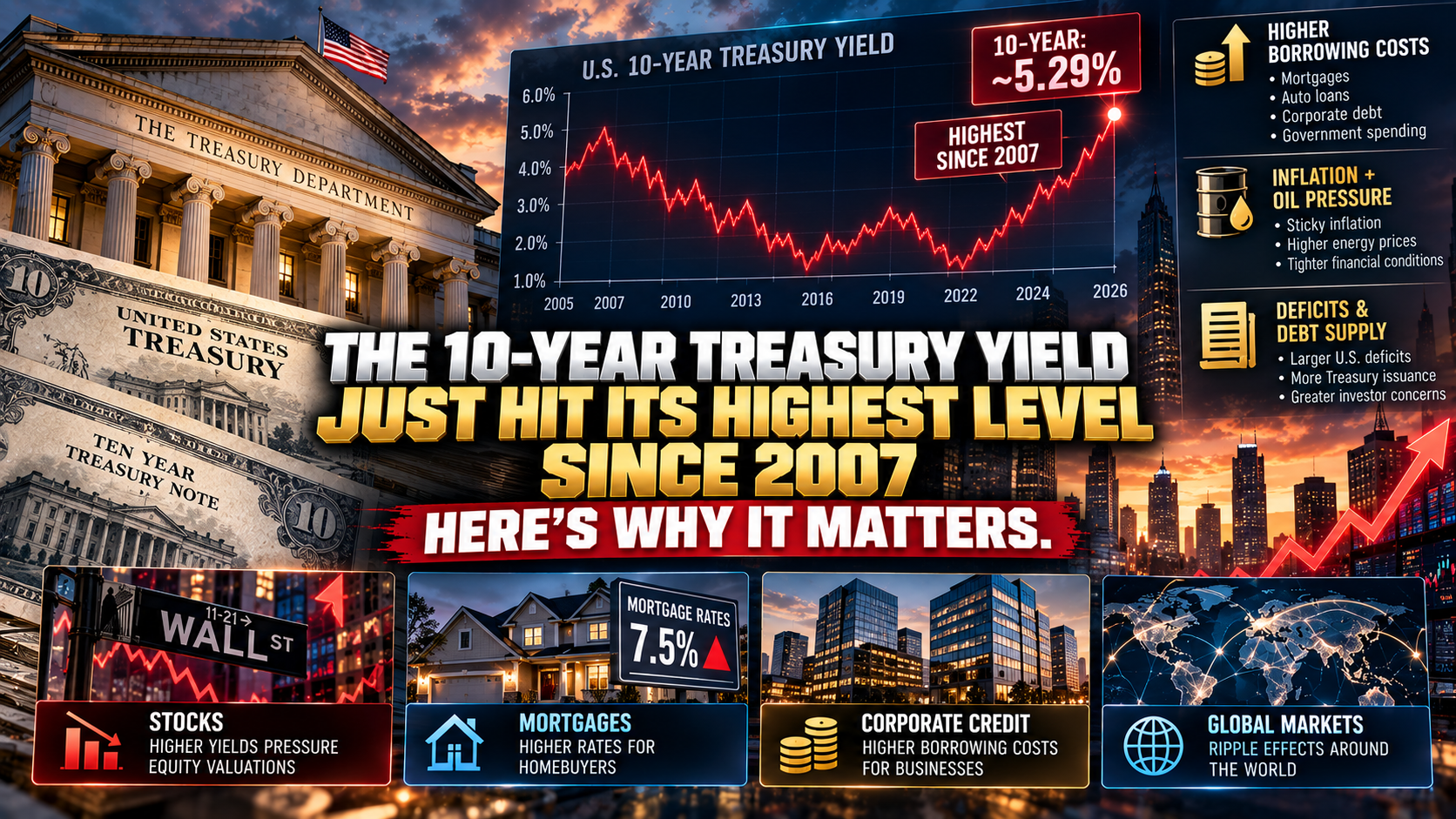








The last time the 10-year Treasury yield traded where it does today, the iPhone was a few weeks old, Lehman Brothers still existed and the global financial crisis had not yet begun. That was July 2007.
On Thursday, the benchmark yield climbed 10 basis points to 5.21%. The 30-year bond pushed to just shy of 5.5%, its highest level since 2004. The five-year note breached 5% for the first time since 2007 the day before.
The 10-year Treasury yield is arguably the most important interest rate in the world. It sets the price of mortgages, car loans, corporate borrowing and government debt far beyond American borders. When it moves this fast, it rewrites the cost of almost everything that involves borrowing money.
How fast the 10-year Treasury yield has climbed
The speed of this move is what has unsettled investors.
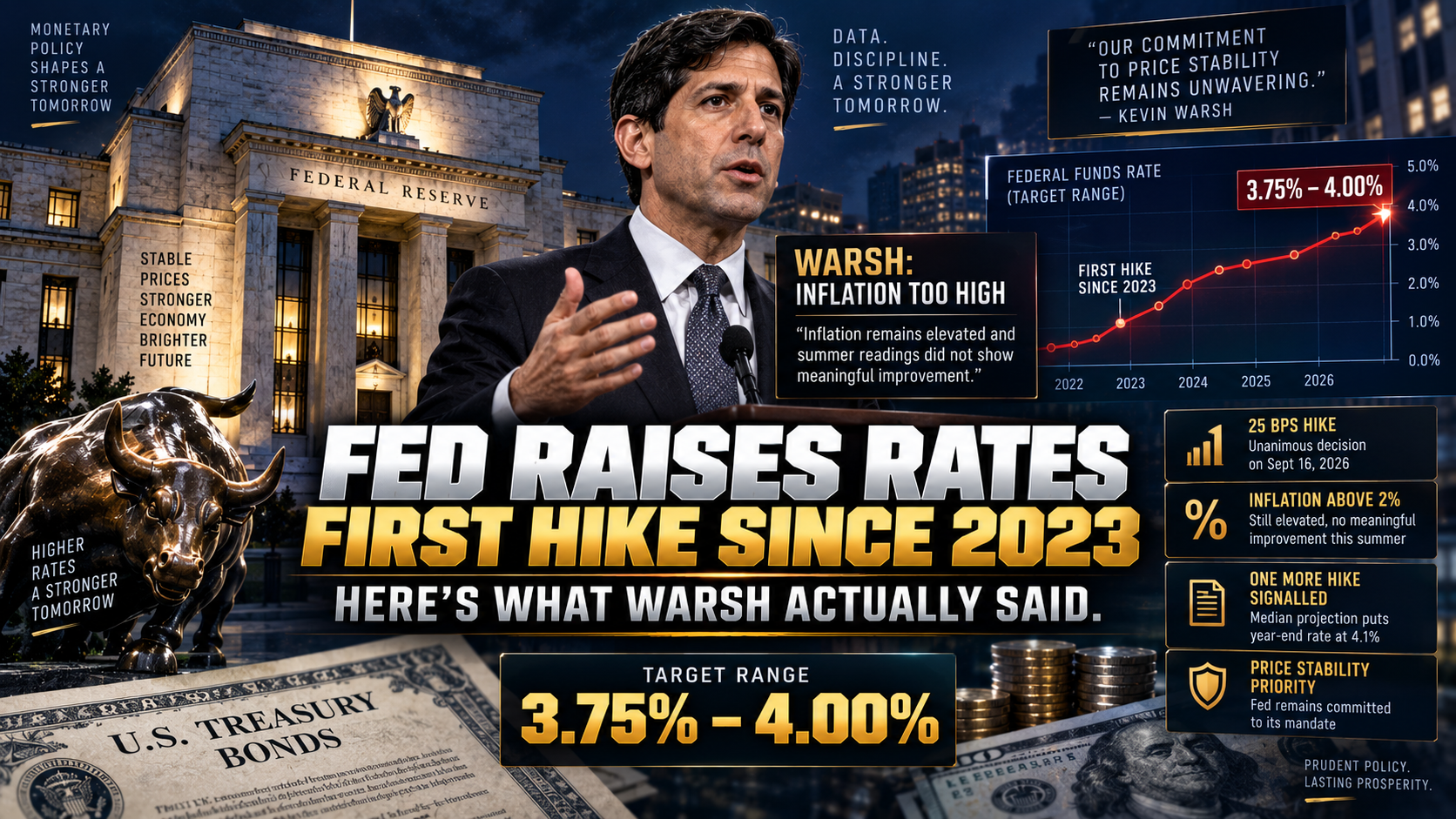
In early September, the yield was still sitting just below 5%. Then, on 15 September, the day before the Federal Reserve’s policy decision, it reached 5.041%, the highest level since July 2007, as oil prices surged on the Iran conflict and traders braced for a rate hike. The Fed duly raised rates the following day, lifting its benchmark to a range of 3.75% to 4%, the first increase since 2023.
Rather than calming the bond market, the hike seemed to intensify selling. On Wednesday, 23 September, the 10-year jumped 16 basis points to 5.12% in a single session. Robust economic data and a weak Treasury auction combined with rising oil prices to push yields across most maturities to their highest levels in almost two decades. Thursday then added another 10 basis points.
A move of that size across a few days would be notable in any market. In the world’s deepest and most liquid bond market, it is exceptional.
Why yields are rising: the four pressures
Wall Street does not agree on a single explanation, and that disagreement is itself part of the problem. Four forces are pushing in the same direction at once.
1. Inflation driven by energy
The war involving Iran has disrupted oil supply through the Strait of Hormuz for months. Energy prices feed directly into inflation, and inflation erodes the real value of fixed bond payments. Investors therefore demand higher yields to compensate. Every time crude has spiked this month, Treasuries have sold off in response.
2. A more hawkish Federal Reserve
Chairman Kevin Warsh has repeatedly described inflation as “a choice,” signalling that the Fed intends to keep tightening until prices come down. This week, Fed governor Michael Barr added that additional rate hikes are needed to bring down sticky inflation. Traders raised bets on another hike in October to around 70%, and markets are pricing roughly a 95% chance of an increase by December.
3. A flood of bond supply
Governments are borrowing heavily, and so are corporations. The build-out of artificial intelligence infrastructure has driven a wave of corporate debt issuance, adding to the supply of bonds competing for investor money. More supply, with no matching rise in demand, pushes prices down and yields up. The weak auction on Wednesday was a reminder that buyers are becoming more selective.
4. Concern about the deficit
Mounting government debt means investors increasingly demand extra compensation for holding long-dated Treasuries. That “term premium” has been rising, particularly at the long end of the curve, which explains why the 30-year bond has moved even more dramatically than shorter maturities.
What the 10-year Treasury yield means for your money
This is not an abstract market story. The 10-year yield feeds directly into the borrowing costs of ordinary households.
Mortgages. Home loan rates track the 10-year closely. Freddie Mac’s weekly survey showed the average 30-year fixed mortgage rising to 7.03% this week, the first reading above 7% since January 2025. A year ago it was 6.30%.
Car loans and personal credit. Auto lenders and personal loan providers price off Treasury yields. Expect higher quoted rates on new financing.
Savings and cash. There is an upside. High-yield savings accounts, money market funds and short-dated Treasury bills pay significantly more than they did a year ago. For savers, this is the most attractive environment in nearly two decades.
Retirement portfolios. When yields rise, existing bond prices fall. Anyone holding bond funds has seen paper losses this month, although new money invested today locks in much higher income.
The stock market’s surprising resilience
Given all of this, the equity market has held up remarkably well. The S&P 500 finished Friday at 7,743.41, up 0.51% on the day, while the Dow rose 0.93% to 51,828.62 and the Nasdaq Composite gained about 0.5%. That closed out the S&P 500’s first winning week in three, and the index remains close to the all-time high it set last month.
Analysts at Charles Schwab offered one explanation: the climb in yields has been relatively orderly, inflation is only slightly high and economic conditions have not deteriorated. Falling oil prices also helped on Friday, with Brent dropping to around $97 a barrel on hopes that the Strait of Hormuz could reopen.
However, the prospect that higher interest rates are here to stay is unnerving investors who fear that eventually something has to break. Higher yields raise the discount rate applied to future company earnings, which weighs most heavily on expensive growth stocks. They also make bonds a more attractive alternative to equities for the first time in years.
Is 5% a ceiling or a floor?
Five percent is more than a round number. It is the level at which financing homes, companies and the federal government moves into a range last seen before the 2008 crisis.
The bull case for bonds is that yields have overshot. If oil continues to fall on Middle East diplomacy and inflation data cools, the Fed could pause after one more hike, and yields could retreat quickly. Buyers who lock in 5% now would benefit.
The bear case is that this is a structural reset rather than a spike. Persistent deficits, heavy AI-related borrowing and a central bank committed to fighting inflation could keep yields elevated for years. In that world, the era of cheap money that defined the 2010s is genuinely over.
The truth probably sits somewhere in between. Nevertheless, both scenarios suggest that the ultra-low rates of the past decade are not coming back soon.
What to watch next week
The calendar is busy, and every release will move bonds.
- Wednesday: August personal income and spending, including the PCE price index, the Fed’s preferred inflation measure. A hot reading would reinforce the case for an October hike.
- Thursday: ISM manufacturing data and weekly jobless claims.
- Friday: The September employment report. Strong hiring would keep the pressure on yields; a weak number could offer relief.
Beyond the data, watch oil. Crude has been the single most reliable driver of the bond market this month. Any breakthrough on reopening Hormuz would likely pull yields lower faster than any economic report.
A short history of 5%
The 10-year yield last lived above 5% in the summer of 2007, just before the collapse of the subprime mortgage market triggered the global financial crisis. What followed was more than a decade of historically low rates.
Through the 2010s, the benchmark spent long stretches between roughly 1.5% and 3%. During the pandemic in 2020, it fell below 1% as investors rushed into safe assets and the Federal Reserve cut its policy rate to near zero. An entire generation of homebuyers, businesses and governments grew accustomed to money that was, by historical standards, almost free.
That changed in 2022, when the Fed began raising rates aggressively to fight post-pandemic inflation. In October 2023, the 10-year briefly approached 5% before retreating. This month, it has not only returned to that level but pushed well beyond it, surpassing the 2023 peaks and reaching territory unseen in almost two decades.
Seen in that context, today’s yields are not extreme by long-run historical standards. In the 1980s, the 10-year traded far higher. What makes the current move so disruptive is the contrast with the recent past, and the fact that so much debt was taken on when rates were a fraction of today’s level.
The bottom line
The 10-year Treasury yield has reached levels that most working adults have never seen in their borrowing lives. It reflects a combination of energy-driven inflation, a determined Federal Reserve, heavy borrowing and growing concern about the deficit. For borrowers, it means higher costs across the board. For savers, it means the best returns on cash in almost 20 years.
Whether 5% becomes a ceiling or a new floor will be decided over the coming weeks by oil, inflation data and the Fed. Either way, the cost of money has changed, and household budgets will need to adjust with it.
This article is for general information only and does not constitute financial advice.